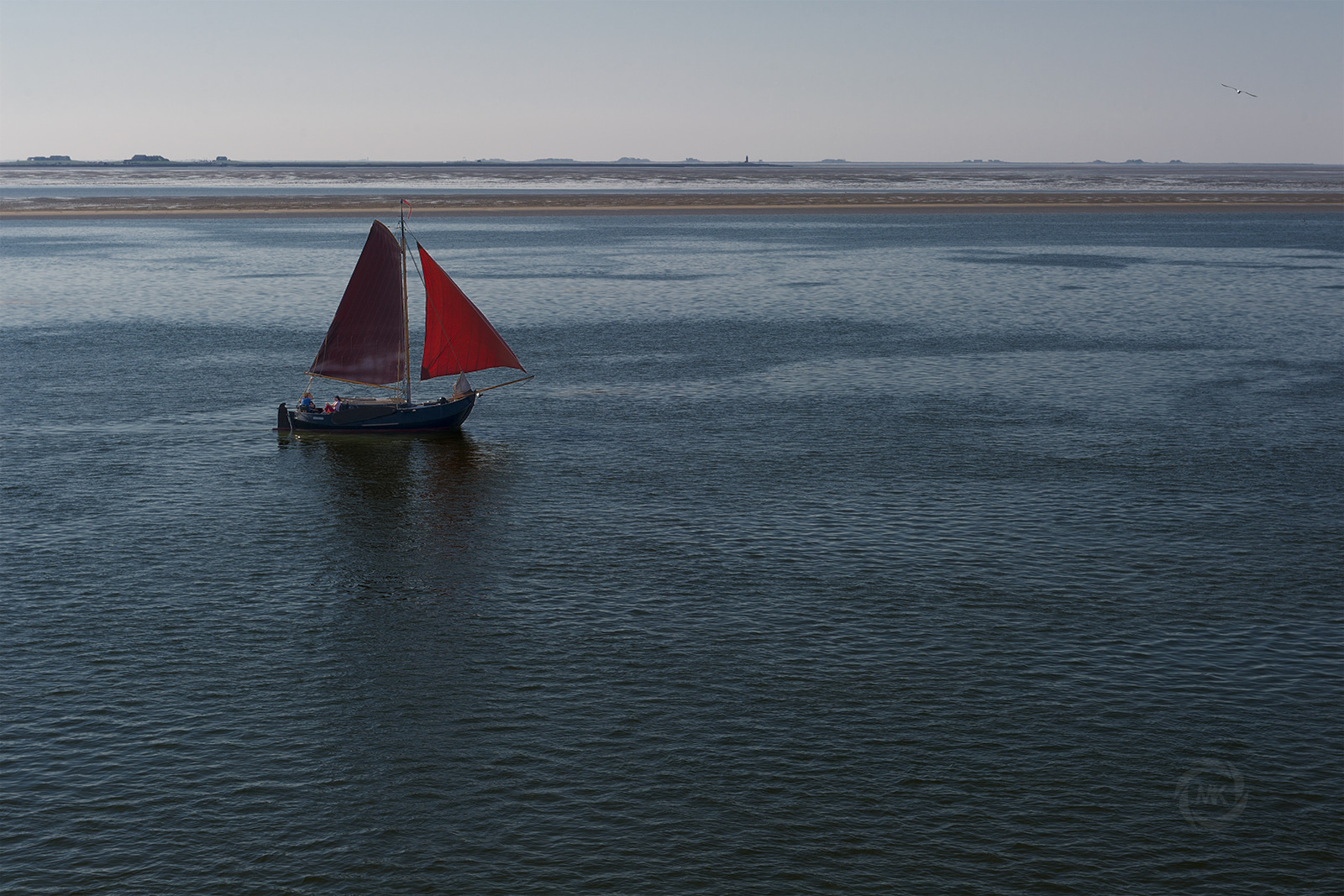
In the mudflats near Amrum. The Dutch sailboats are still maneuverable even at very low tide because they have side-mounted retractable centerboards. In the background, you can see the elongated Hallig Langeneß with its dwelling mounds. Halligen are not islands because they are defenseless against the forces of the sea (at high tide, they lie just above sea level). In winter, they are often flooded. The dwelling mounds are man-made earth hills on which the houses are built. This keeps them above the water during storm floods. Occasionally, houses have to be torn down to raise the mounds (the sea level keeps rising "thanks to" climate change). Then the houses are rebuilt on the new, higher mounds.In the mudflats near Amrum. The Dutch sailboats are still maneuverable even at very low tide because they have side-mounted retractable centerboards. In the background, you can see the elongated Hallig Langeneß with its dwelling mounds. Halligen are not islands because they are defenseless against the forces of the sea (at high tide, they lie just above sea level). In winter, they are often flooded. The dwelling mounds are man-made earth hills on which the houses are built. This keeps them above the water during storm floods. Occasionally, houses have to be torn down to raise the mounds (the sea level keeps rising "thanks to" climate change). Then the houses are rebuilt on the new, higher mounds.im Watt vor Amrum. Die Holländischen Segler sind auch bei sehr niedrigem Wasserstand noch manövrierbar, da sie seitlich hochklappbare Schwerter haben.
Im Hintergrund ist die langestreckte Hallig Langeneß mit ihren Warften zu erkennen. Halligen sind keine Inseln da sie den Gewalten des Meeres schutzlos ausgeliefert sind (sie liegen bei Flut nur knapp über dem Meeresspiegel. Im Winter werden sie häufig überflutet. Die Warften sind aufgeschüttete Erdhügel, auf denen die Häuser gebaut wurden. So bleiben sie bei einer Sturmflut über dem Wasser. Hin und wieder müssen die Häuser abgerissen werden, um die Waften erhöhen zu können (der Meeresspiegel steigt "dank" des Klimawandels immer weiter). Dann werden die Häuser auf den neuen, höheren Warften neu aufgebaut.




Dutch SailboatDutch SailboatHollandsegler
In the mudflats near Amrum. The Dutch sailboats are still maneuverable even at very low tide because they have side-mounted retractable centerboards. In the background, you can see the elongated Hallig Langeneß with its dwelling mounds. Halligen are not islands because they are defenseless against the forces of the sea (at high tide, they lie just above sea level). In winter, they are often flooded. The dwelling mounds are man-made earth hills on which the houses are built. This keeps them above the water during storm floods. Occasionally, houses have to be torn down to raise the mounds (the sea level keeps rising "thanks to" climate change). Then the houses are rebuilt on the new, higher mounds.In the mudflats near Amrum. The Dutch sailboats are still maneuverable even at very low tide because they have side-mounted retractable centerboards. In the background, you can see the elongated Hallig Langeneß with its dwelling mounds. Halligen are not islands because they are defenseless against the forces of the sea (at high tide, they lie just above sea level). In winter, they are often flooded. The dwelling mounds are man-made earth hills on which the houses are built. This keeps them above the water during storm floods. Occasionally, houses have to be torn down to raise the mounds (the sea level keeps rising "thanks to" climate change). Then the houses are rebuilt on the new, higher mounds.im Watt vor Amrum. Die Holländischen Segler sind auch bei sehr niedrigem Wasserstand noch manövrierbar, da sie seitlich hochklappbare Schwerter haben.Im Hintergrund ist die langestreckte Hallig Langeneß mit ihren Warften zu erkennen. Halligen sind keine Inseln da sie den Gewalten des Meeres schutzlos ausgeliefert sind (sie liegen bei Flut nur knapp über dem Meeresspiegel. Im Winter werden sie häufig überflutet. Die Warften sind aufgeschüttete Erdhügel, auf denen die Häuser gebaut wurden. So bleiben sie bei einer Sturmflut über dem Wasser. Hin und wieder müssen die Häuser abgerissen werden, um die Waften erhöhen zu können (der Meeresspiegel steigt "dank" des Klimawandels immer weiter). Dann werden die Häuser auf den neuen, höheren Warften neu aufgebaut.