Sh2-114 is a faint emission nebula in the constellation Cygnus and is a small cloud with a filamentary shape. It apparently consists of several overlapping arc-shaped filaments. The arcs have a semicircular shape with a depression oriented towards the south. It is suspected that, together with the nearby cloud Sh2-113, it forms a bubble shape that looks like a supernova remnant. However, no supernova has been recorded or described in this region to date.
19.5 hours of exposure time: Taken from my small remote observatory in Deidesheim. Telescope is a TS Photoline 102/714mm, focal length reduced to 585mm. Camera is a ZWO ASi294mc pro. A photo is created from many individual images with 300sec or 600sec exposure times, which are stacked and combined into a composite image. This way, photons can be collected over many nights, days, or weeks. Here, it was three consecutive days.Sh2-114 is a faint emission nebula in the constellation Cygnus and is a small cloud with a filamentary shape. It apparently consists of several overlapping arc-shaped filaments. The arcs have a semicircular shape with a depression oriented towards the south. It is suspected that, together with the nearby cloud Sh2-113, it forms a bubble shape that looks like a supernova remnant. However, no supernova has been recorded or described in this region to date.
19.5 hours of exposure time: Taken from my small remote observatory in Deidesheim. Telescope is a TS Photoline 102/714mm, focal length reduced to 585mm. Camera is a ZWO ASi294mc pro. A photo is created from many individual images with 300sec or 600sec exposure times, which are stacked and combined into a composite image. This way, photons can be collected over many nights, days, or weeks. Here, it was three consecutive days.Sh2-114 ist ein schwacher Emissionsnebel im Sternbild Schwan und ist eine kleine Wolke, die eine strähnige Form hat. Sie besteht offenbar aus mehreren übereinander liegenden bogenförmigen Filamenten. Die Bögen haben eine halbrunde Form mit einer Vertiefung, die in Richtung Süden ausgerichtet ist. Es liegt der Verdacht nahe, dass es sich dabei zusammen mit der nahe gelegenen Wolke Sh2-113 um eine Blasenform handelt, die wie ein Supernova-Überrest aussieht. Bis heute wurde jedoch noch keine Supernova in dieser Region aufgezeichnet oder beschrieben.
19,5 Stunden Belichtungszeit: Aufgenommen aus meiner kleinen Remotesternwarte in Deidesheim. Teleskop ein TS Photoline 102/714mm, Brennweitenreduzierung auf 585mm. Kamera eine ZWO ASi294mc pro. Ein Foto entsteht aus vielen Einzelbildern mit 300sec oder auch 600sec, diese werden gestackt und zu einem Summenbild gerechnet. So kann man Photonen über viele Nächte über Tage oder Wochen sammeln. Hier waren es drei Tage am Stück.


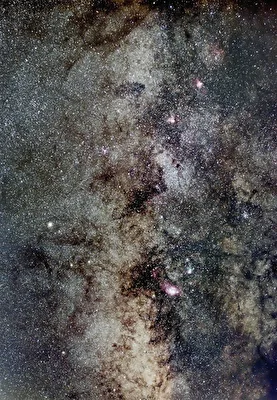





SH2-114 the flying dragon
Sh2-114 is a faint emission nebula in the constellation Cygnus and is a small cloud with a filamentary shape. It apparently consists of several overlapping arc-shaped filaments. The arcs have a semicircular shape with a depression oriented towards the south. It is suspected that, together with the nearby cloud Sh2-113, it forms a bubble shape that looks like a supernova remnant. However, no supernova has been recorded or described in this region to date.19.5 hours of exposure time: Taken from my small remote observatory in Deidesheim. Telescope is a TS Photoline 102/714mm, focal length reduced to 585mm. Camera is a ZWO ASi294mc pro. A photo is created from many individual images with 300sec or 600sec exposure times, which are stacked and combined into a composite image. This way, photons can be collected over many nights, days, or weeks. Here, it was three consecutive days.Sh2-114 is a faint emission nebula in the constellation Cygnus and is a small cloud with a filamentary shape. It apparently consists of several overlapping arc-shaped filaments. The arcs have a semicircular shape with a depression oriented towards the south. It is suspected that, together with the nearby cloud Sh2-113, it forms a bubble shape that looks like a supernova remnant. However, no supernova has been recorded or described in this region to date.
19.5 hours of exposure time: Taken from my small remote observatory in Deidesheim. Telescope is a TS Photoline 102/714mm, focal length reduced to 585mm. Camera is a ZWO ASi294mc pro. A photo is created from many individual images with 300sec or 600sec exposure times, which are stacked and combined into a composite image. This way, photons can be collected over many nights, days, or weeks. Here, it was three consecutive days.Sh2-114 ist ein schwacher Emissionsnebel im Sternbild Schwan und ist eine kleine Wolke, die eine strähnige Form hat. Sie besteht offenbar aus mehreren übereinander liegenden bogenförmigen Filamenten. Die Bögen haben eine halbrunde Form mit einer Vertiefung, die in Richtung Süden ausgerichtet ist. Es liegt der Verdacht nahe, dass es sich dabei zusammen mit der nahe gelegenen Wolke Sh2-113 um eine Blasenform handelt, die wie ein Supernova-Überrest aussieht. Bis heute wurde jedoch noch keine Supernova in dieser Region aufgezeichnet oder beschrieben.
19,5 Stunden Belichtungszeit: Aufgenommen aus meiner kleinen Remotesternwarte in Deidesheim. Teleskop ein TS Photoline 102/714mm, Brennweitenreduzierung auf 585mm. Kamera eine ZWO ASi294mc pro. Ein Foto entsteht aus vielen Einzelbildern mit 300sec oder auch 600sec, diese werden gestackt und zu einem Summenbild gerechnet. So kann man Photonen über viele Nächte über Tage oder Wochen sammeln. Hier waren es drei Tage am Stück.