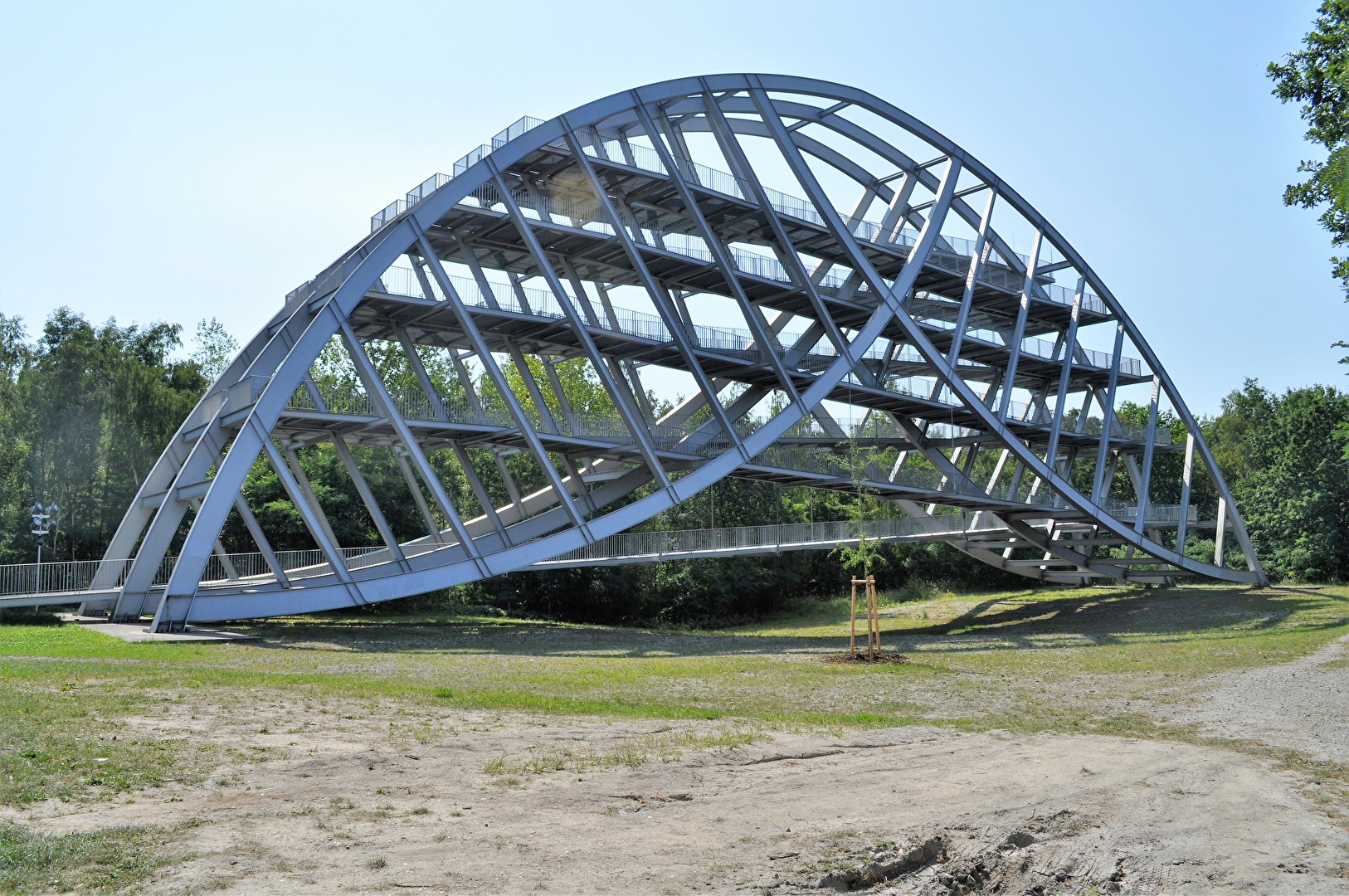
Since 2006, Bitterfeld and the region around the Goitzsche have gained a powerful landmark. On Bitterfelder Berg rises a sweeping steel arch structure. From a distance, the structure resembles bridge architecture.
The largest sculpture to date by the Frankfurt artist Claus Bury offers the viewer a variety of associations. Some see in the artwork an oversized Schwibbogen (decorative arch), others see the grabber of a lignite excavator – but the artist probably borrowed the form from the movement of an excavator bucket. While the concave shape is meant to represent the pits of the Goitzsche, the convex shapes symbolize the heap buildup of the slag heap at Bitterfelder Berg. Symbolically, the Bitterfelder Bogen is meant to bridge the gap from the old industrial plants to the modern chemical park and from lignite open-cast mining to the landscaped environment.
The arch is 28 m high and 81 m long. It can be walked on a 540 m long zigzag path...Since 2006, Bitterfeld and the region around the Goitzsche have gained a powerful landmark. On Bitterfelder Berg rises a sweeping steel arch structure. From a distance, the structure resembles bridge architecture.
The largest sculpture to date by the Frankfurt artist Claus Bury offers the viewer a variety of associations. Some see in the artwork an oversized Schwibbogen (decorative arch), others see the grabber of a lignite excavator – but the artist probably borrowed the form from the movement of an excavator bucket. While the concave shape is meant to represent the pits of the Goitzsche, the convex shapes symbolize the heap buildup of the slag heap at Bitterfelder Berg. Symbolically, the Bitterfelder Bogen is meant to bridge the gap from the old industrial plants to the modern chemical park and from lignite open-cast mining to the landscaped environment.
The arch is 28 m high and 81 m long. It can be walked on a 540 m long zigzag path...Seit 2006 sind Bitterfeld und die Region um die Goitzsche um eine mächtige Landmarke reicher. Auf dem Bitterfelder Berg erhebt sich eine schwungvolle stählerne Bogenkonstruktion. Aus der Ferne erinnert die Konstruktion an eine Brückenarchitektur.
Die bisher größte Skulptur des Frankfurter Künstlers Claus Bury erlaubt dem Betrachter eine Vielzahl von Assoziationsmöglichkeiten. Manche sehen in dem Kunstwerk einen überdimensionalen Schwibbbogen, andere sehen den Greifer eines Braunkohlebaggers - der Künstler entlehnte die Form aber wohl der Bewegung einer Baggerschaufel. Während die konkave Form für die Gruben der Goitzsche stehen sollen, symbolisieren die konvexen Formen die Aufschüttung der Halde zum Bitterfelder Berg. Symbolisch soll mit dem Bitterfelder Bogen die Brücke von den Altindustrieanlagen zum modernen Chemie-Park und vom Braunkohletagebau zur gestalteten Landschaft geschlagen werden.
Der Bogen ist 28 m hoch und 81 m lang. Er kann auf einer im Zickzack geführten 540 m langen




Bitterfelder Bogen
Since 2006, Bitterfeld and the region around the Goitzsche have gained a powerful landmark. On Bitterfelder Berg rises a sweeping steel arch structure. From a distance, the structure resembles bridge architecture.The largest sculpture to date by the Frankfurt artist Claus Bury offers the viewer a variety of associations. Some see in the artwork an oversized Schwibbogen (decorative arch), others see the grabber of a lignite excavator – but the artist probably borrowed the form from the movement of an excavator bucket. While the concave shape is meant to represent the pits of the Goitzsche, the convex shapes symbolize the heap buildup of the slag heap at Bitterfelder Berg. Symbolically, the Bitterfelder Bogen is meant to bridge the gap from the old industrial plants to the modern chemical park and from lignite open-cast mining to the landscaped environment.
The arch is 28 m high and 81 m long. It can be walked on a 540 m long zigzag path...Since 2006, Bitterfeld and the region around the Goitzsche have gained a powerful landmark. On Bitterfelder Berg rises a sweeping steel arch structure. From a distance, the structure resembles bridge architecture.
The largest sculpture to date by the Frankfurt artist Claus Bury offers the viewer a variety of associations. Some see in the artwork an oversized Schwibbogen (decorative arch), others see the grabber of a lignite excavator – but the artist probably borrowed the form from the movement of an excavator bucket. While the concave shape is meant to represent the pits of the Goitzsche, the convex shapes symbolize the heap buildup of the slag heap at Bitterfelder Berg. Symbolically, the Bitterfelder Bogen is meant to bridge the gap from the old industrial plants to the modern chemical park and from lignite open-cast mining to the landscaped environment.
The arch is 28 m high and 81 m long. It can be walked on a 540 m long zigzag path...Seit 2006 sind Bitterfeld und die Region um die Goitzsche um eine mächtige Landmarke reicher. Auf dem Bitterfelder Berg erhebt sich eine schwungvolle stählerne Bogenkonstruktion. Aus der Ferne erinnert die Konstruktion an eine Brückenarchitektur.
Die bisher größte Skulptur des Frankfurter Künstlers Claus Bury erlaubt dem Betrachter eine Vielzahl von Assoziationsmöglichkeiten. Manche sehen in dem Kunstwerk einen überdimensionalen Schwibbbogen, andere sehen den Greifer eines Braunkohlebaggers - der Künstler entlehnte die Form aber wohl der Bewegung einer Baggerschaufel. Während die konkave Form für die Gruben der Goitzsche stehen sollen, symbolisieren die konvexen Formen die Aufschüttung der Halde zum Bitterfelder Berg. Symbolisch soll mit dem Bitterfelder Bogen die Brücke von den Altindustrieanlagen zum modernen Chemie-Park und vom Braunkohletagebau zur gestalteten Landschaft geschlagen werden.
Der Bogen ist 28 m hoch und 81 m lang. Er kann auf einer im Zickzack geführten 540 m langen