IC 59 and 63, two nebulae in Sh2-185IC 59 and 63, two nebulae in Sh2-185IC 59 und 63, zwei Nebel in Sh2-185
IC 59 and 63, two nebulae in Sh2-185 with 17 hours of exposure time.
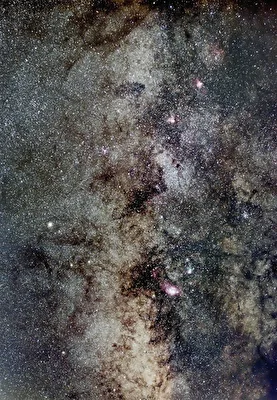
The current image shows a large section of the central part of Cassiopeia. IC 63 is the brighter of the two nebulae about 24' northeast of the 2.4 mag bright star Gamma Cassiopeiae (γ Cas). IC 59, the second nebula, is significantly fainter and harder to see in this image. Both nebulae form the brightest area of the HII region Sh2-185 and simultaneously shape the northern edge of a 3° x 2° bubble of ionized hydrogen. However, this bubble is only detectable with very long exposure times using Hα filtering and was first presented on deep Hα plates (Plate 11, Dubout-Crillon 1976).IC 59 and 63, two nebulae in Sh2-185 with 17 hours of exposure time.
The current image shows a large section of the central part of Cassiopeia. IC 63 is the brighter of the two nebulae about 24' northeast of the 2.4 mag bright star Gamma Cassiopeiae (γ Cas). IC 59, the second nebula, is significantly fainter and harder to see in this image. Both nebulae form the brightest area of the HII region Sh2-185 and simultaneously shape the northern edge of a 3° x 2° bubble of ionized hydrogen. However, this bubble is only detectable with very long exposure times using Hα filtering and was first presented on deep Hα plates (Plate 11, Dubout-Crillon 1976).IC 59 und 63, zwei Nebel in Sh2-185 mit 17 Stunden Belichtungszeit.
Das aktuelle Bild zeigt einen großen Ausschnitt aus dem zentralen Teil der Cassiopeia. IC 63 ist der hellere von zwei Nebeln ca. 24' nordöstlich des 2,4 mag hellen Sterns Gamma Cassiopeiae (γ Cas). IC 59, der zweite Nebel, ist deutlich lichtschwächer und hier im Bild schwieriger zu erkennen. Beide Nebel bilden den hellsten Bereich der HII-Region Sh2-185 und formen dabei gleichzeitig den nördlichen Rand einer 3° x 2° großen Blase aus ionisiertem Wasserstoff. Diese Blase ist aber nur bei sehr langer Belichtungszeit über Hα-Filterung nachweisbar und wurde erstmals auf tiefen Hα-Platten vorgestellt (Plate 11, Dubout-Crillon 1976).






IC 59 and 63, two nebulae in Sh2-185IC 59 and 63, two nebulae in Sh2-185IC 59 und 63, zwei Nebel in Sh2-185
IC 59 and 63, two nebulae in Sh2-185 with 17 hours of exposure time.The current image shows a large section of the central part of Cassiopeia. IC 63 is the brighter of the two nebulae about 24' northeast of the 2.4 mag bright star Gamma Cassiopeiae (γ Cas). IC 59, the second nebula, is significantly fainter and harder to see in this image. Both nebulae form the brightest area of the HII region Sh2-185 and simultaneously shape the northern edge of a 3° x 2° bubble of ionized hydrogen. However, this bubble is only detectable with very long exposure times using Hα filtering and was first presented on deep Hα plates (Plate 11, Dubout-Crillon 1976).IC 59 and 63, two nebulae in Sh2-185 with 17 hours of exposure time.
The current image shows a large section of the central part of Cassiopeia. IC 63 is the brighter of the two nebulae about 24' northeast of the 2.4 mag bright star Gamma Cassiopeiae (γ Cas). IC 59, the second nebula, is significantly fainter and harder to see in this image. Both nebulae form the brightest area of the HII region Sh2-185 and simultaneously shape the northern edge of a 3° x 2° bubble of ionized hydrogen. However, this bubble is only detectable with very long exposure times using Hα filtering and was first presented on deep Hα plates (Plate 11, Dubout-Crillon 1976).IC 59 und 63, zwei Nebel in Sh2-185 mit 17 Stunden Belichtungszeit.
Das aktuelle Bild zeigt einen großen Ausschnitt aus dem zentralen Teil der Cassiopeia. IC 63 ist der hellere von zwei Nebeln ca. 24' nordöstlich des 2,4 mag hellen Sterns Gamma Cassiopeiae (γ Cas). IC 59, der zweite Nebel, ist deutlich lichtschwächer und hier im Bild schwieriger zu erkennen. Beide Nebel bilden den hellsten Bereich der HII-Region Sh2-185 und formen dabei gleichzeitig den nördlichen Rand einer 3° x 2° großen Blase aus ionisiertem Wasserstoff. Diese Blase ist aber nur bei sehr langer Belichtungszeit über Hα-Filterung nachweisbar und wurde erstmals auf tiefen Hα-Platten vorgestellt (Plate 11, Dubout-Crillon 1976).