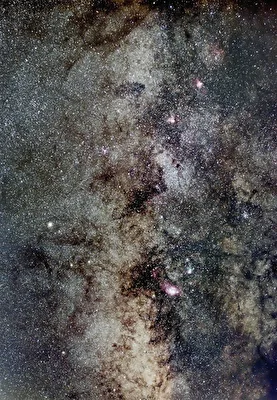
The image shows the Tulip Nebula with an exposure time of 650 minutes.
Sharpless 101 (Sh2-101) is an emission nebula (HII region) in the constellation Cygnus. It is sometimes called the Tulip Nebula because its outline appears to resemble a tulip in photographs. It was cataloged by the astronomer Stewart Sharpless in his 1959 catalog of nebulae. It is located about 7,000 light-years from Earth.
Sh2-101 is located, at least in the area visible from Earth, in close proximity to the microquasar Cygnus X-1, where one of the first suspected black holes was discovered. Cygnus X-1 is about 15′ west of Sh2-101. The companion star of Cygnus X-1 is a supergiant of spectral class O9.7 Iab with a mass of 21 solar masses and 20 times the radius of the Sun. The binary system has a period of 5.8 days, and the pair is separated by 0.2 astronomical units. The black hole has eThe image shows the Tulip Nebula with an exposure time of 650 minutes.
Sharpless 101 (Sh2-101) is an emission nebula (HII region) in the constellation Cygnus. It is sometimes called the Tulip Nebula because its outline appears to resemble a tulip in photographs. It was cataloged by the astronomer Stewart Sharpless in his 1959 catalog of nebulae. It is located about 7,000 light-years from Earth.
Sh2-101 is located, at least in the area visible from Earth, in close proximity to the microquasar Cygnus X-1, where one of the first suspected black holes was discovered. Cygnus X-1 is about 15′ west of Sh2-101. The companion star of Cygnus X-1 is a supergiant of spectral class O9.7 Iab with a mass of 21 solar masses and 20 times the radius of the Sun. The binary system has a period of 5.8 days, and the pair is separated by 0.2 astronomical units. The black hole has eDie Aufnahme zeigt den Tulpennebel mit 650 Minuten Belichtungszeit.
Sharpless 101 (Sh2-101) ist ein Emissionsnebel (HII-Region) im Sternbild Cygnus. Er wird manchmal auch als Tulpennebel bezeichnet, weil er fotografisch dem Umriss einer Tulpe zu ähneln scheint. Er wurde von dem Astronomen Stewart Sharpless in seinem 1959 erschienenen Katalog der Nebel katalogisiert. Er befindet sich in einer Entfernung von etwa 7.000 Lichtjahren von der Erde.
Sh2-101 befindet sich, zumindest in dem von der Erde aus gesehenen Bereich, in unmittelbarer Nähe des Mikroquasars Cygnus X-1, in dem eines der ersten vermuteten Schwarzen Löcher entdeckt wurde. Cygnus X-1 befindet sich etwa 15′ westlich von Sh2-101. Der Begleitstern von Cygnus X-1 ist ein Überriese der Spektralklasse O9.7 Iab mit einer Masse von 21 Sonnenmassen und dem 20-fachen Radius der Sonne. Die Periode des Doppelsternsystems beträgt 5,8 Tage, und das Paar ist um 0,2 Astronomische Einheiten voneinander entfernt. Das schwarze Loch hat e


















SH2-101 Tulip NebulaSH2-101 Tulip NebulaSH2-101 Tulpennebel
The image shows the Tulip Nebula with an exposure time of 650 minutes.Sharpless 101 (Sh2-101) is an emission nebula (HII region) in the constellation Cygnus. It is sometimes called the Tulip Nebula because its outline appears to resemble a tulip in photographs. It was cataloged by the astronomer Stewart Sharpless in his 1959 catalog of nebulae. It is located about 7,000 light-years from Earth.
Sh2-101 is located, at least in the area visible from Earth, in close proximity to the microquasar Cygnus X-1, where one of the first suspected black holes was discovered. Cygnus X-1 is about 15′ west of Sh2-101. The companion star of Cygnus X-1 is a supergiant of spectral class O9.7 Iab with a mass of 21 solar masses and 20 times the radius of the Sun. The binary system has a period of 5.8 days, and the pair is separated by 0.2 astronomical units. The black hole has eThe image shows the Tulip Nebula with an exposure time of 650 minutes.
Sharpless 101 (Sh2-101) is an emission nebula (HII region) in the constellation Cygnus. It is sometimes called the Tulip Nebula because its outline appears to resemble a tulip in photographs. It was cataloged by the astronomer Stewart Sharpless in his 1959 catalog of nebulae. It is located about 7,000 light-years from Earth.
Sh2-101 is located, at least in the area visible from Earth, in close proximity to the microquasar Cygnus X-1, where one of the first suspected black holes was discovered. Cygnus X-1 is about 15′ west of Sh2-101. The companion star of Cygnus X-1 is a supergiant of spectral class O9.7 Iab with a mass of 21 solar masses and 20 times the radius of the Sun. The binary system has a period of 5.8 days, and the pair is separated by 0.2 astronomical units. The black hole has eDie Aufnahme zeigt den Tulpennebel mit 650 Minuten Belichtungszeit.
Sharpless 101 (Sh2-101) ist ein Emissionsnebel (HII-Region) im Sternbild Cygnus. Er wird manchmal auch als Tulpennebel bezeichnet, weil er fotografisch dem Umriss einer Tulpe zu ähneln scheint. Er wurde von dem Astronomen Stewart Sharpless in seinem 1959 erschienenen Katalog der Nebel katalogisiert. Er befindet sich in einer Entfernung von etwa 7.000 Lichtjahren von der Erde.
Sh2-101 befindet sich, zumindest in dem von der Erde aus gesehenen Bereich, in unmittelbarer Nähe des Mikroquasars Cygnus X-1, in dem eines der ersten vermuteten Schwarzen Löcher entdeckt wurde. Cygnus X-1 befindet sich etwa 15′ westlich von Sh2-101. Der Begleitstern von Cygnus X-1 ist ein Überriese der Spektralklasse O9.7 Iab mit einer Masse von 21 Sonnenmassen und dem 20-fachen Radius der Sonne. Die Periode des Doppelsternsystems beträgt 5,8 Tage, und das Paar ist um 0,2 Astronomische Einheiten voneinander entfernt. Das schwarze Loch hat e