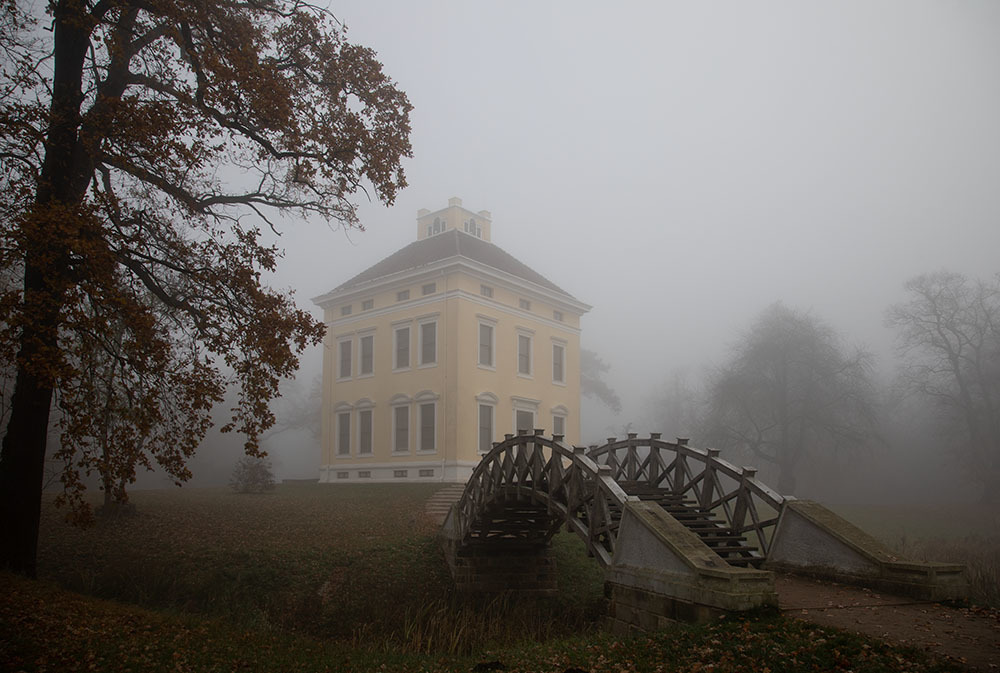
Luisium Palace in the Fog
In place of the Baroque park and its buildings, an English garden with Neoclassical and Neo-Gothic architecture was laid out. Since 1780, the name Luisium has been used in honor of the princess. Besides Luisium and Wörlitz Palace, Luise mainly lived in the Grey House in Wörlitz Park.' role="button">
Jürgen Nickel


Info
Exif
| Manufacturer | Canon |
| Model | Canon EOS 5D Mark IV |
| Exposure time | 1/200 |
| ISO | 100 |
| Fade | f/6.3 |
| Focal length | 24 mm |
| Shutter speed | 0.005013 sec |
| Flash | Blitz aus (manuell) |
| Date | 12.11.2021 |






Luisium Palace in the FogLuisium Palace in the FogSchloß Luisium im Nebel
Luisium refers to a palace and park located in the Waldersee district east of the city center of Dessau-Roßlau in Anhalt. Like the Wörlitz Gardens, it is part of the Dessau-Wörlitz Garden Realm, which is listed as a UNESCO World Heritage Site.The Luisium palace and garden were created between 1774 and 1778 as a gift for Princess Luise of Brandenburg-Schwedt, wife of Prince Leopold III Friedrich Franz of Anhalt-Dessau, and were intended to serve as the princess's widow's residence. The predecessor of the garden was a Baroque-style park called Vogelherd, where Prince Franz already owned a two-story palace in his youth.
In place of the Baroque park and its buildings, an English garden with Neoclassical and Neo-Gothic architecture was laid out. Since 1780, the name Luisium has been used in honor of the princess. Besides Luisium and Wörlitz Palace, Luise mainly lived in the Grey House in Wörlitz Park.Luisium refers to a palace and park located in the Waldersee district east of the city center of Dessau-Roßlau in Anhalt. Like the Wörlitz Gardens, it is part of the Dessau-Wörlitz Garden Realm, which is listed as a UNESCO World Heritage Site.
The Luisium palace and garden were created between 1774 and 1778 as a gift for Princess Luise of Brandenburg-Schwedt, wife of Prince Leopold III Friedrich Franz of Anhalt-Dessau, and were intended to serve as the princess's widow's residence. The predecessor of the garden was a Baroque-style park called Vogelherd, where Prince Franz already owned a two-story palace in his youth.
In place of the Baroque park and its buildings, an English garden with Neoclassical and Neo-Gothic architecture was laid out. Since 1780, the name Luisium has been used in honor of the princess. Besides Luisium and Wörlitz Palace, Luise mainly lived in the Grey House in Wörlitz Park.Luisium bezeichnet ein Schloss und eine Parkanlage im östlich des Stadtzentrums der anhaltischen Stadt Dessau-Roßlau gelegenen Ortsteil Waldersee. Es ist wie die Wörlitzer Anlagen Teil des Dessau-Wörlitzer Gartenreichs, das auf der Liste des Welterbes der Menschheit der UNESCO steht.
Schloss und Garten Luisium entstanden zwischen 1774 und 1778 als Geschenk für die Fürstin Luise von Brandenburg-Schwedt, der Gemahlin des Fürsten Leopold III. Friedrich Franz von Anhalt-Dessau, und sollte der Fürstin als Witwensitz dienen. Der Vorgänger der Gartenanlage war ein Park im Stile des Barock, der sogenannte Vogelherd, wo Fürst Franz in seiner Jugendzeit bereits ein zweigeschossiges Schloss besaß.
An Stelle des barocken Parks und seiner Gebäude wurde ein englischer Garten mit klassizistischen und neugotischen Architekturen angelegt. Seit 1780 ist der Name Luisium nach der Fürstin in Gebrauch. Neben dem Luisium und dem Schloss Wörlitz bewohnte Luise vorwiegend das Graue Haus im Wörlitzer Park. 1