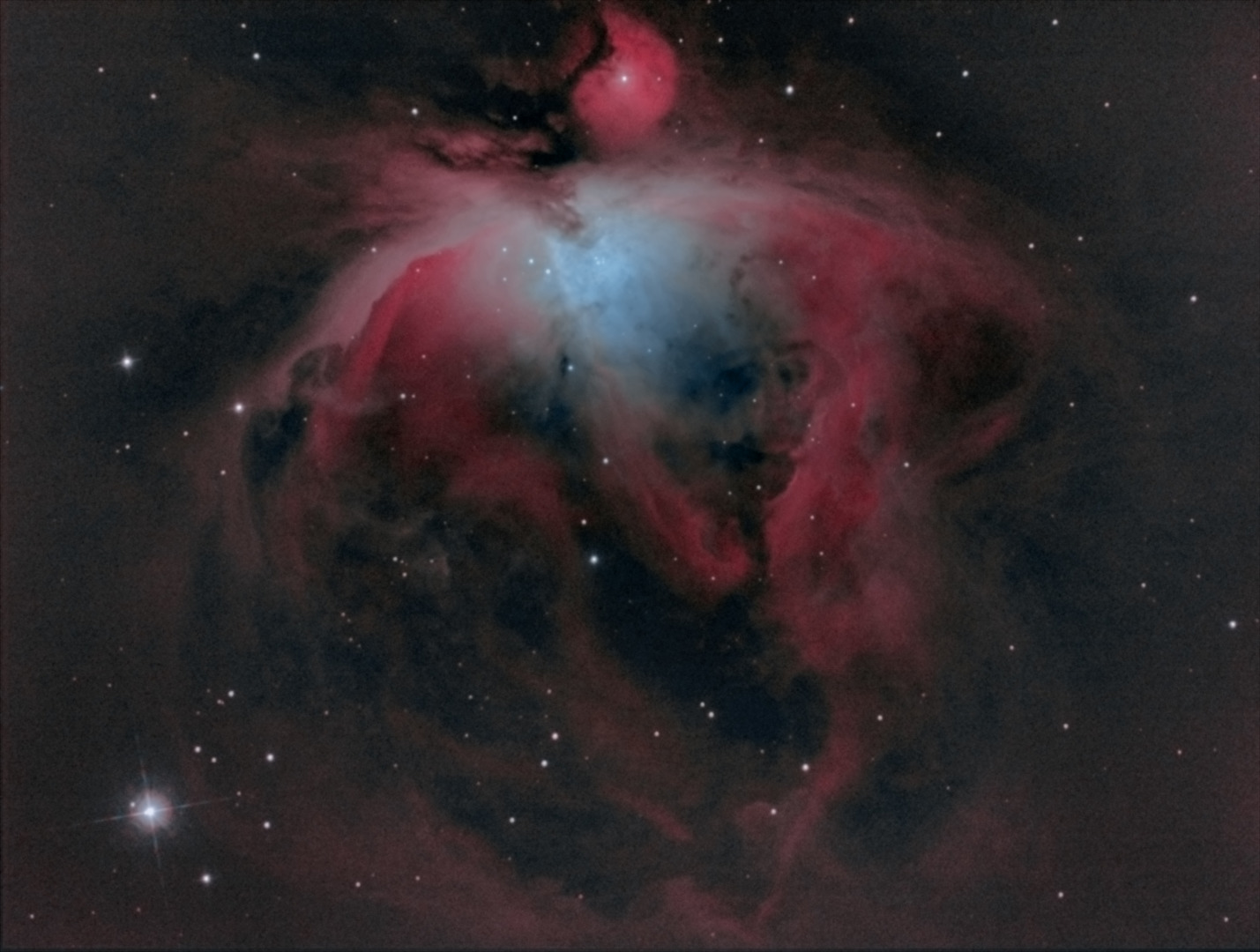
Science Orion Nebula M42
The Orion Nebula is a subregion of the interstellar molecular cloud OMC-1 in the Orion Molecular Cloud Complex. It consists mainly of hydrogen. Stars are forming within the nebula, whose ionizing radiation causes the nebula to glow in the visible spectrum. It is therefore classified as an H II region. At a distance of about 414 parsecs (1350 light-years), it is one of the most active star-forming regions in the galactic neighborhood, making it a preferred subject for studying star formation. It is expected to eventually develop into an open star cluster similar to the Pleiades.' role="button">
Michael Geissel
The Orion Nebula is a subregion of the interstellar molecular cloud OMC-1 in the Orion Molecular Cloud Complex. It consists mainly of hydrogen. Stars are forming within the nebula, whose ionizing radiation causes the nebula to glow in the visible spectrum. It is therefore classified as an H II region. At a distance of about 414 parsecs (1350 light-years), it is one of the most active star-forming regions in the galactic neighborhood, making it a preferred subject for studying star formation. It is expected to eventually develop into an open star cluster similar to the Pleiades.' role="button">




Information
Exif
| Date | 13.10.2018 |











Science Orion Nebula M42Science Orion Nebula M42Wissenschaft Orionnebel M42
The Orion Nebula (catalog designation M 42 or NGC 1976) is an emission nebula in the constellation Orion. Due to the high apparent brightness of its center above magnitude 4, the nebula is easily visible to the naked eye as star-like, forming part of Orion's Sword south of the three stars of Orion's Belt. It has an angular size of about one degree.The Orion Nebula is a subregion of the interstellar molecular cloud OMC-1 in the Orion Molecular Cloud Complex. It consists mainly of hydrogen. Stars are forming within the nebula, whose ionizing radiation causes the nebula to glow in the visible spectrum. It is therefore classified as an H II region. At a distance of about 414 parsecs (1350 light-years), it is one of the most active star-forming regions in the galactic neighborhood, making it a preferred subject for studying star formation. It is expected to eventually develop into an open star cluster similar to the Pleiades.The Orion Nebula (catalog designation M 42 or NGC 1976) is an emission nebula in the constellation Orion. Due to the high apparent brightness of its center above magnitude 4, the nebula is easily visible to the naked eye as star-like, forming part of Orion's Sword south of the three stars of Orion's Belt. It has an angular size of about one degree.
The Orion Nebula is a subregion of the interstellar molecular cloud OMC-1 in the Orion Molecular Cloud Complex. It consists mainly of hydrogen. Stars are forming within the nebula, whose ionizing radiation causes the nebula to glow in the visible spectrum. It is therefore classified as an H II region. At a distance of about 414 parsecs (1350 light-years), it is one of the most active star-forming regions in the galactic neighborhood, making it a preferred subject for studying star formation. It is expected to eventually develop into an open star cluster similar to the Pleiades.Der Orionnebel (Katalogbezeichnung M 42 oder NGC 1976) ist ein Emissionsnebel im Sternbild Orion. Durch die große scheinbare Helligkeit seines Zentrums oberhalb der 4. Magnitude ist der Nebel mit bloßem Auge sternähnlich als Teil des Schwertes des Orions südlich der drei Sterne des Oriongürtels gut sichtbar. Insgesamt besitzt er eine Winkelausdehnung von etwa einem Grad.
Der Orionnebel ist ein Teilgebiet der interstellaren Molekülwolke OMC-1 im Orion-Molekülwolkenkomplex. Er besteht überwiegend aus Wasserstoff. In dem Nebel entstehen Sterne, deren ionisierende Strahlung den Nebel im sichtbaren Bereich leuchten lässt. Er wird daher auch als H-II-Gebiet klassifiziert. Mit einer Entfernung von etwa 414 Parsec (1350 Lichtjahre) ist er in der galaktischen Nachbarschaft eines der aktivsten Sternentstehungsgebiete, weshalb er ein bevorzugtes Untersuchungsobjekt zur Erforschung der Sternentstehung ist. Er wird sich voraussichtlich zu einem den Plejaden ähnlichen, offenen Sternhaufen entwick