Today at Lake Zwenkau:
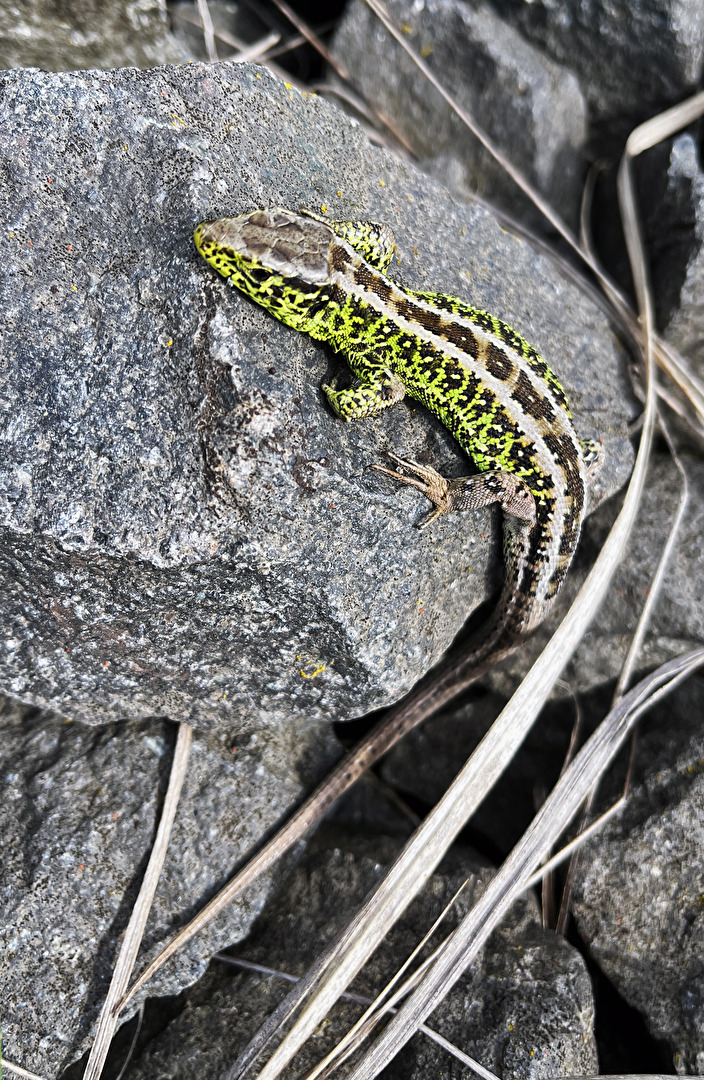
The animal shown is a sand lizard (Lacerta agilis).
Appearance: Males develop a striking bright green flank coloration during the mating season in spring.
Habitat: They prefer sunny places with hiding spots such as quarries, railway embankments, or heathlands.
Protection status: Sand lizards are strictly protected in Germany and must not be disturbed or captured.Today at Lake Zwenkau:
The animal shown is a sand lizard (Lacerta agilis).
Appearance: Males develop a striking bright green flank coloration during the mating season in spring.
Habitat: They prefer sunny places with hiding spots such as quarries, railway embankments, or heathlands.
Protection status: Sand lizards are strictly protected in Germany and must not be disturbed or captured.Heute am Zwenkauer See:
Bei dem abgebildeten Tier handelt es sich um eine Zauneidechse (Lacerta agilis).
Aussehen: Männchen entwickeln während der Paarungszeit im Frühjahr eine auffällig leuchtend grüne Flankenfärbung.
Lebensraum: Sie bevorzugen sonnige Orte mit Versteckmöglichkeiten wie Steinbrüche, Bahndämme oder Heidegebiete.
Schutzstatus: Zauneidechsen sind in Deutschland streng geschützt und dürfen nicht gestört oder gefangen werden.















Sand LizardSand LizardZauneidechse
Today at Lake Zwenkau:The animal shown is a sand lizard (Lacerta agilis).
Appearance: Males develop a striking bright green flank coloration during the mating season in spring.
Habitat: They prefer sunny places with hiding spots such as quarries, railway embankments, or heathlands.
Protection status: Sand lizards are strictly protected in Germany and must not be disturbed or captured.Today at Lake Zwenkau:
The animal shown is a sand lizard (Lacerta agilis).
Appearance: Males develop a striking bright green flank coloration during the mating season in spring.
Habitat: They prefer sunny places with hiding spots such as quarries, railway embankments, or heathlands.
Protection status: Sand lizards are strictly protected in Germany and must not be disturbed or captured.Heute am Zwenkauer See:
Bei dem abgebildeten Tier handelt es sich um eine Zauneidechse (Lacerta agilis).
Aussehen: Männchen entwickeln während der Paarungszeit im Frühjahr eine auffällig leuchtend grüne Flankenfärbung.
Lebensraum: Sie bevorzugen sonnige Orte mit Versteckmöglichkeiten wie Steinbrüche, Bahndämme oder Heidegebiete.
Schutzstatus: Zauneidechsen sind in Deutschland streng geschützt und dürfen nicht gestört oder gefangen werden.