SH2-296 Seagull Wings with 3.2 Hours Exposure Time.
The complex of gas and dust clouds with additional stars of the Canis Major OB1 association spans about 200 light-years. The Seagull Nebula is approximately 3800 light-years away from us.
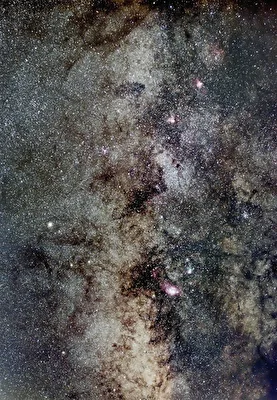
The broad Seagull Nebula is likely part of a larger shell structure swept by successive supernova explosions. It is cataloged as Sh2-296 and IC 2177. The distinctive bluish arc below the center on the right is the bow shock of the runaway star FN Canis Majoris. In the center, a gas bubble is visible, and at the top of the wing, to the right of the crack, there is a distortion (small light arc) that could indicate gravitational lensing. The image was sent to astrophysicists at HdA in Heidelberg.SH2-296 Seagull Wings with 3.2 Hours Exposure Time.
The complex of gas and dust clouds with additional stars of the Canis Major OB1 association spans about 200 light-years. The Seagull Nebula is approximately 3800 light-years away from us.
The broad Seagull Nebula is likely part of a larger shell structure swept by successive supernova explosions. It is cataloged as Sh2-296 and IC 2177. The distinctive bluish arc below the center on the right is the bow shock of the runaway star FN Canis Majoris. In the center, a gas bubble is visible, and at the top of the wing, to the right of the crack, there is a distortion (small light arc) that could indicate gravitational lensing. The image was sent to astrophysicists at HdA in Heidelberg.SH2-296 Seemöwenflügel mit 3,2 Stunden Belichtungszeit.
Der Komplex aus Gas- und Staubwolken mit weiteren Sternen der Canis-Majoris-OB1-Assoziation umfasst etwa 200 Lichtjahre. Der Möwennebel ist ungefähr 3800 Lichtjahre von uns entfernt.
Der breite Möwennebel ist wahrscheinlich Teil einer größeren Hüllenstruktur, die von aufeinanderfolgenden Supernovaexplosionen gefegt wurde. Er ist als Sh2-296 und IC 2177 katalogisiert. Der markante bläuliche Bogen rechts unter der Mitte ist die Bugwelle des Ausreißersterns FN Canis Majoris. In der Mitte ist eine Gasblase erkennbar und oben im Flügel, rechts neben dem Riss ist eine Verzerrung (kleiner Lichtbogen) was auf eine Gravitationsverzerrung hinweisen könnte. Bild wurde an Astrophysiker zum HdA nach Heidelberg geschickt.










SH2-296 Seagull NebulaSH2-296 Seagull NebulaSH2-296 Seemöwennebel
SH2-296 Seagull Wings with 3.2 Hours Exposure Time.The complex of gas and dust clouds with additional stars of the Canis Major OB1 association spans about 200 light-years. The Seagull Nebula is approximately 3800 light-years away from us.
The broad Seagull Nebula is likely part of a larger shell structure swept by successive supernova explosions. It is cataloged as Sh2-296 and IC 2177. The distinctive bluish arc below the center on the right is the bow shock of the runaway star FN Canis Majoris. In the center, a gas bubble is visible, and at the top of the wing, to the right of the crack, there is a distortion (small light arc) that could indicate gravitational lensing. The image was sent to astrophysicists at HdA in Heidelberg.SH2-296 Seagull Wings with 3.2 Hours Exposure Time.
The complex of gas and dust clouds with additional stars of the Canis Major OB1 association spans about 200 light-years. The Seagull Nebula is approximately 3800 light-years away from us.
The broad Seagull Nebula is likely part of a larger shell structure swept by successive supernova explosions. It is cataloged as Sh2-296 and IC 2177. The distinctive bluish arc below the center on the right is the bow shock of the runaway star FN Canis Majoris. In the center, a gas bubble is visible, and at the top of the wing, to the right of the crack, there is a distortion (small light arc) that could indicate gravitational lensing. The image was sent to astrophysicists at HdA in Heidelberg.SH2-296 Seemöwenflügel mit 3,2 Stunden Belichtungszeit.
Der Komplex aus Gas- und Staubwolken mit weiteren Sternen der Canis-Majoris-OB1-Assoziation umfasst etwa 200 Lichtjahre. Der Möwennebel ist ungefähr 3800 Lichtjahre von uns entfernt.
Der breite Möwennebel ist wahrscheinlich Teil einer größeren Hüllenstruktur, die von aufeinanderfolgenden Supernovaexplosionen gefegt wurde. Er ist als Sh2-296 und IC 2177 katalogisiert. Der markante bläuliche Bogen rechts unter der Mitte ist die Bugwelle des Ausreißersterns FN Canis Majoris. In der Mitte ist eine Gasblase erkennbar und oben im Flügel, rechts neben dem Riss ist eine Verzerrung (kleiner Lichtbogen) was auf eine Gravitationsverzerrung hinweisen könnte. Bild wurde an Astrophysiker zum HdA nach Heidelberg geschickt.