Living BeautifullyLiving BeautifullySchöner wohnen
The Cube House (also Cube Apartment, Treehouse) is a design pattern for residential buildings developed by architect Piet Blom based on cube-shaped structures standing on one corner. Two building complexes composed modularly of these structures were built in Helmond and Rotterdam.
Piet Blom created the first designs for the Cube Houses in 1972. Blom envisioned the houses as trees with a "trunk" for vertical access and the living unit as the "tree crown."
The trunk has a hexagonal floor plan and consists of three reinforced concrete columns completed with concrete blocks. On the ground floor, there is a storage room, and an external staircase leads to the elevated entrance. In Rotterdam, there are two other variants: in one, both the storage room and entrance are on the ground floor with an internal staircase; in the other, three houses share one staircase, with a shop on the ground floor and storage rooms located elsewhere in the complex.
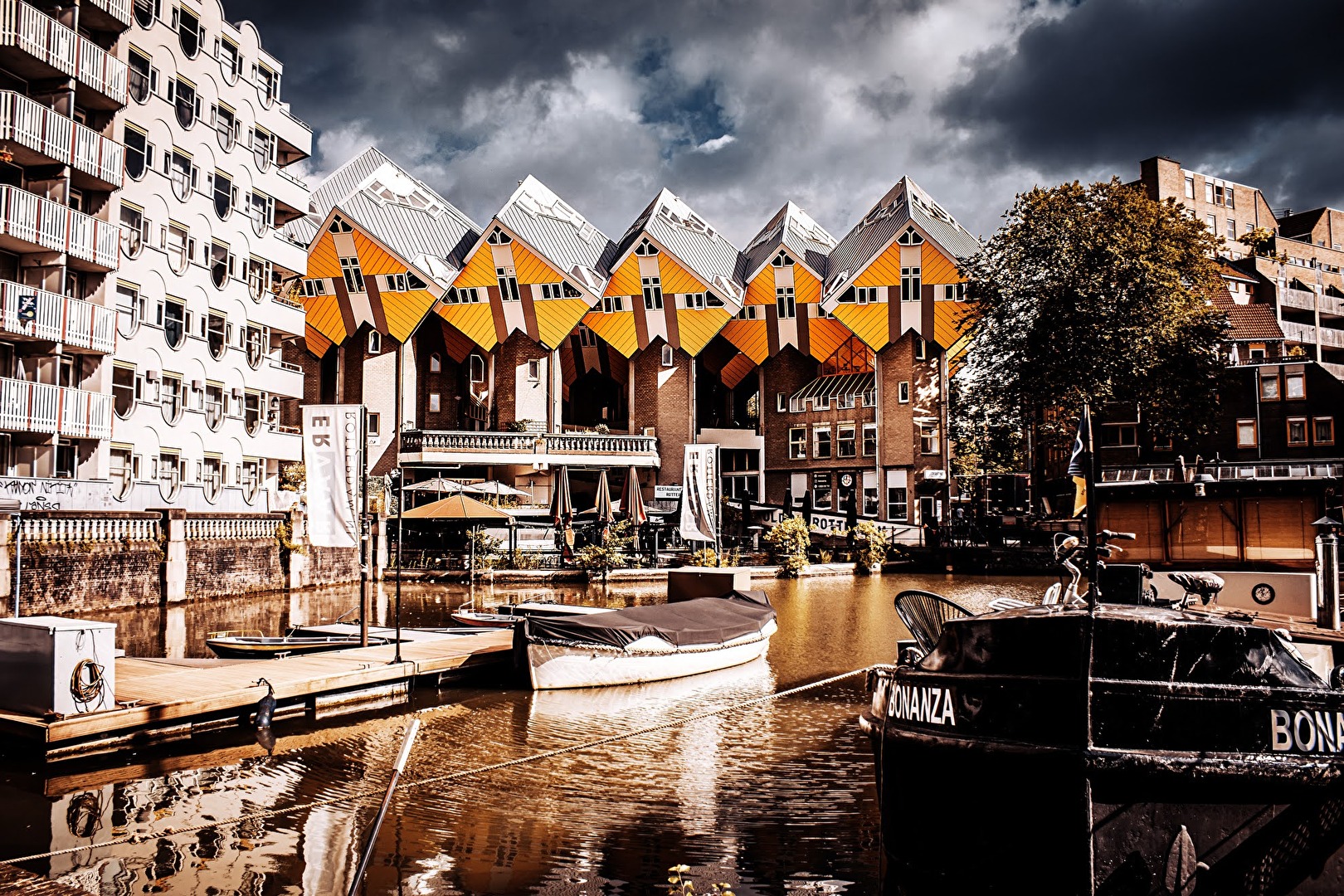
The cube, with an edge length of 7.5 meters, is tilted and stands on one corner so that three sides face down and three face up. Blom referred to it as "street house" and "sky house." The supporting structure and floor slabs are made of in-situ concrete, while the exterior walls are constructed in timber frame with pine wood. The floor area is approximately 100 m² (excluding the trunk). All buildings are supplied by a central heating system.The Cube House (also Cube Apartment, Treehouse) is a design pattern for residential buildings developed by architect Piet Blom based on cube-shaped structures standing on one corner. Two building complexes composed modularly of these structures were built in Helmond and Rotterdam.
Piet Blom created the first designs for the Cube Houses in 1972. Blom envisioned the houses as trees with a "trunk" for vertical access and the living unit as the "tree crown."
The trunk has a hexagonal floor plan and consists of three reinforced concrete columns completed with concrete blocks. On the ground floor, there is a storage room, and an external staircase leads to the elevated entrance. In Rotterdam, there are two other variants: in one, both the storage room and entrance are on the ground floor with an internal staircase; in the other, three houses share one staircase, with a shop on the ground floor and storage rooms located elsewhere in the complex.
The cube, with an edge length of 7.5 meters, is tilted and stands on one corner so that three sides face down and three face up. Blom referred to it as "street house" and "sky house." The supporting structure and floor slabs are made of in-situ concrete, while the exterior walls are constructed in timber frame with pine wood. The floor area is approximately 100 m² (excluding the trunk). All buildings are supplied by a central heating system.Das Kubushaus (auch Kubuswohnung, Baumhaus) ist ein Entwurfsmuster für Wohngebäude, das von dem Architekten Piet Blom auf der Basis von würfelförmigen, auf einer Ecke stehenden Baukörpern entwickelt wurde. In Helmond und Rotterdam wurden zwei Gebäudekomplexe errichtet, die modular aus diesen Baukörpern zusammengesetzt wurden.
Die ersten Entwürfe für die Kubushäuser fertigte Piet Blom 1972[1] an. Blom sah die Häuser als Bäume mit einem „Stamm“ zur vertikalen Erschließung und der Wohneinheit als „Baumkrone“.
Der Stamm hat einen sechseckigen Grundriss und besteht aus drei Stahlbetonsäulen, die mit Betonblocksteinen vervollständigt werden. Im Erdgeschoss ist ein Vorratsraum untergebracht, eine externe Treppe führt zum höher gelegenen Eingang. In Rotterdam gibt es zwei weitere Varianten: Bei der einen liegen Vorratsraum und Eingang beide im Erdgeschoss und die Treppe ist intern. Bei der anderen Variante teilen sich drei Häuser eine Treppe und im Erdgeschoss ist ein Laden untergebracht. Die Vorratsräume liegen anderswo im Komplex.
Der Kubus mit der Kantenlänge von 7,5 Metern ist gekippt und steht auf einer Ecke, so dass drei Seiten nach unten und drei nach oben zeigen. Blom sprach von „Straßenhaus“ und „Himmelshaus“. Das Tragwerk und die Geschossplatten bestehen aus Ortbeton, die Außenwände sind in Holzskelettbauweise aus Kiefernholz errichtet. Die Geschossfläche beträgt circa 100 m² (ohne den Stamm). Alle Gebäude werden von einer zentralen Heizungsanlage versorgt.














Living BeautifullyLiving BeautifullySchöner wohnen
The Cube House (also Cube Apartment, Treehouse) is a design pattern for residential buildings developed by architect Piet Blom based on cube-shaped structures standing on one corner. Two building complexes composed modularly of these structures were built in Helmond and Rotterdam.Piet Blom created the first designs for the Cube Houses in 1972. Blom envisioned the houses as trees with a "trunk" for vertical access and the living unit as the "tree crown."
The trunk has a hexagonal floor plan and consists of three reinforced concrete columns completed with concrete blocks. On the ground floor, there is a storage room, and an external staircase leads to the elevated entrance. In Rotterdam, there are two other variants: in one, both the storage room and entrance are on the ground floor with an internal staircase; in the other, three houses share one staircase, with a shop on the ground floor and storage rooms located elsewhere in the complex.
The cube, with an edge length of 7.5 meters, is tilted and stands on one corner so that three sides face down and three face up. Blom referred to it as "street house" and "sky house." The supporting structure and floor slabs are made of in-situ concrete, while the exterior walls are constructed in timber frame with pine wood. The floor area is approximately 100 m² (excluding the trunk). All buildings are supplied by a central heating system.The Cube House (also Cube Apartment, Treehouse) is a design pattern for residential buildings developed by architect Piet Blom based on cube-shaped structures standing on one corner. Two building complexes composed modularly of these structures were built in Helmond and Rotterdam.
Piet Blom created the first designs for the Cube Houses in 1972. Blom envisioned the houses as trees with a "trunk" for vertical access and the living unit as the "tree crown."
The trunk has a hexagonal floor plan and consists of three reinforced concrete columns completed with concrete blocks. On the ground floor, there is a storage room, and an external staircase leads to the elevated entrance. In Rotterdam, there are two other variants: in one, both the storage room and entrance are on the ground floor with an internal staircase; in the other, three houses share one staircase, with a shop on the ground floor and storage rooms located elsewhere in the complex.
The cube, with an edge length of 7.5 meters, is tilted and stands on one corner so that three sides face down and three face up. Blom referred to it as "street house" and "sky house." The supporting structure and floor slabs are made of in-situ concrete, while the exterior walls are constructed in timber frame with pine wood. The floor area is approximately 100 m² (excluding the trunk). All buildings are supplied by a central heating system.Das Kubushaus (auch Kubuswohnung, Baumhaus) ist ein Entwurfsmuster für Wohngebäude, das von dem Architekten Piet Blom auf der Basis von würfelförmigen, auf einer Ecke stehenden Baukörpern entwickelt wurde. In Helmond und Rotterdam wurden zwei Gebäudekomplexe errichtet, die modular aus diesen Baukörpern zusammengesetzt wurden.
Die ersten Entwürfe für die Kubushäuser fertigte Piet Blom 1972[1] an. Blom sah die Häuser als Bäume mit einem „Stamm“ zur vertikalen Erschließung und der Wohneinheit als „Baumkrone“.
Der Stamm hat einen sechseckigen Grundriss und besteht aus drei Stahlbetonsäulen, die mit Betonblocksteinen vervollständigt werden. Im Erdgeschoss ist ein Vorratsraum untergebracht, eine externe Treppe führt zum höher gelegenen Eingang. In Rotterdam gibt es zwei weitere Varianten: Bei der einen liegen Vorratsraum und Eingang beide im Erdgeschoss und die Treppe ist intern. Bei der anderen Variante teilen sich drei Häuser eine Treppe und im Erdgeschoss ist ein Laden untergebracht. Die Vorratsräume liegen anderswo im Komplex.
Der Kubus mit der Kantenlänge von 7,5 Metern ist gekippt und steht auf einer Ecke, so dass drei Seiten nach unten und drei nach oben zeigen. Blom sprach von „Straßenhaus“ und „Himmelshaus“. Das Tragwerk und die Geschossplatten bestehen aus Ortbeton, die Außenwände sind in Holzskelettbauweise aus Kiefernholz errichtet. Die Geschossfläche beträgt circa 100 m² (ohne den Stamm). Alle Gebäude werden von einer zentralen Heizungsanlage versorgt.