Rotunda-shaped, column-lined, and covered with a pergola burial siteRotunda-shaped, column-lined, and covered with a pergola burial siterotundenförmige, säulenbestandene und mit einer Pergola bedeckte Grabanlage
The Grave of Architect Emil Franz Hänsel
Emil Franz Hänsel was the most active architect in Leipzig before the First World War. Significant examples of his architectural work in this city include the trade fair buildings "Specks Hof," the "Zentral-Messepalast," the "König-Albert-Haus," and the Hotel "Continental." The Leipzig department store "Brühl," built between 1906 and 1908 and recently demolished except for a facade fragment, is also one of his important works.
On March 30, 1912, his beloved wife and mother of his two children died at the age of only 39. He chose the family grave site No. 44 in Section VI of the Südfriedhof as the future resting place for his family, where his wife was buried on April 3, 1912, in a heavy oak post coffin. The price for the acquired hundred-year usage right of the grave site was 2700 Goldmark.
Later that same year, on December 12, 1912, Emil applied for...The Grave of Architect Emil Franz Hänsel
Emil Franz Hänsel was the most active architect in Leipzig before the First World War. Significant examples of his architectural work in this city include the trade fair buildings "Specks Hof," the "Zentral-Messepalast," the "König-Albert-Haus," and the Hotel "Continental." The Leipzig department store "Brühl," built between 1906 and 1908 and recently demolished except for a facade fragment, is also one of his important works.
On March 30, 1912, his beloved wife and mother of his two children died at the age of only 39. He chose the family grave site No. 44 in Section VI of the Südfriedhof as the future resting place for his family, where his wife was buried on April 3, 1912, in a heavy oak post coffin. The price for the acquired hundred-year usage right of the grave site was 2700 Goldmark.
Later that same year, on December 12, 1912, Emil applied for...Die Grabstätte des Architekten Emil Franz Hänsel
Emil Franz Hänsel ist in der Zeit vor dem Ersten Weltkrieg der meistbeschäftigte Architekt Leipzigs. Besonders mit den Messehäusern „Specks Hof“, dem „Zentral-Messepalast“, dem „König-Albert-Haus“ oder dem Hotel „Continental“ haben sich bedeutende Zeugnisse seiner Baukunst in dieser Stadt erhalten. Auch das in jüngster Zeit bis auf ein Fassadenfragment beseitigte, 1906 – 1908 errichtete Leipziger Kaufhaus „Brühl“ zählt zu den wichtigen Werken dieses Architekten.
Am 30. März 1912 stirbt ihm, erst 39 Jahre alt, die geliebte Gattin und Mutter seiner beiden Kinder.
Er erwählt die in der VI. Abteilung des Südfriedhofes gelegene Wahlstelle No. 44 als die künftige Grabstätte seiner Familie, in der am 03. April 1912 seine Ehefrau in einem schweren eichenen Pfostensarg beerdigt wird.
2700 Goldmark ist der Preis für das erworbene hundertjährige Nutzungsrecht an der Grabstätte.
Noch im gleichen Jahr, am 12. Dezember 1912, beantragt Emil
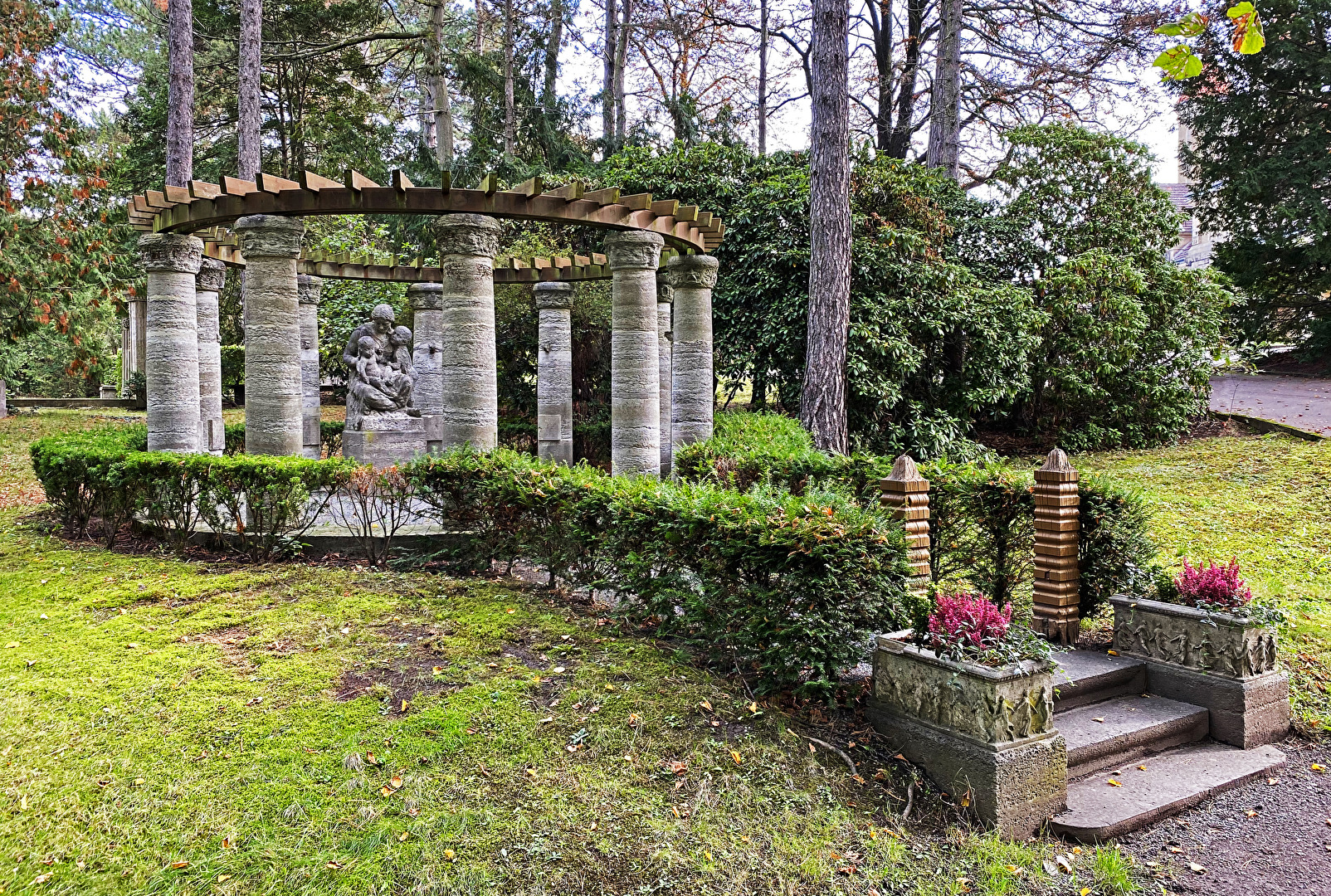





Rotunda-shaped, column-lined, and covered with a pergola burial siteRotunda-shaped, column-lined, and covered with a pergola burial siterotundenförmige, säulenbestandene und mit einer Pergola bedeckte Grabanlage
The Grave of Architect Emil Franz HänselEmil Franz Hänsel was the most active architect in Leipzig before the First World War. Significant examples of his architectural work in this city include the trade fair buildings "Specks Hof," the "Zentral-Messepalast," the "König-Albert-Haus," and the Hotel "Continental." The Leipzig department store "Brühl," built between 1906 and 1908 and recently demolished except for a facade fragment, is also one of his important works.
On March 30, 1912, his beloved wife and mother of his two children died at the age of only 39. He chose the family grave site No. 44 in Section VI of the Südfriedhof as the future resting place for his family, where his wife was buried on April 3, 1912, in a heavy oak post coffin. The price for the acquired hundred-year usage right of the grave site was 2700 Goldmark.
Later that same year, on December 12, 1912, Emil applied for...The Grave of Architect Emil Franz Hänsel
Emil Franz Hänsel was the most active architect in Leipzig before the First World War. Significant examples of his architectural work in this city include the trade fair buildings "Specks Hof," the "Zentral-Messepalast," the "König-Albert-Haus," and the Hotel "Continental." The Leipzig department store "Brühl," built between 1906 and 1908 and recently demolished except for a facade fragment, is also one of his important works.
On March 30, 1912, his beloved wife and mother of his two children died at the age of only 39. He chose the family grave site No. 44 in Section VI of the Südfriedhof as the future resting place for his family, where his wife was buried on April 3, 1912, in a heavy oak post coffin. The price for the acquired hundred-year usage right of the grave site was 2700 Goldmark.
Later that same year, on December 12, 1912, Emil applied for...Die Grabstätte des Architekten Emil Franz Hänsel
Emil Franz Hänsel ist in der Zeit vor dem Ersten Weltkrieg der meistbeschäftigte Architekt Leipzigs. Besonders mit den Messehäusern „Specks Hof“, dem „Zentral-Messepalast“, dem „König-Albert-Haus“ oder dem Hotel „Continental“ haben sich bedeutende Zeugnisse seiner Baukunst in dieser Stadt erhalten. Auch das in jüngster Zeit bis auf ein Fassadenfragment beseitigte, 1906 – 1908 errichtete Leipziger Kaufhaus „Brühl“ zählt zu den wichtigen Werken dieses Architekten.
Am 30. März 1912 stirbt ihm, erst 39 Jahre alt, die geliebte Gattin und Mutter seiner beiden Kinder.
Er erwählt die in der VI. Abteilung des Südfriedhofes gelegene Wahlstelle No. 44 als die künftige Grabstätte seiner Familie, in der am 03. April 1912 seine Ehefrau in einem schweren eichenen Pfostensarg beerdigt wird.
2700 Goldmark ist der Preis für das erworbene hundertjährige Nutzungsrecht an der Grabstätte.
Noch im gleichen Jahr, am 12. Dezember 1912, beantragt Emil