Large Pearl-bordered FritillaryLarge Pearl-bordered FritillaryGroßer Perlmuttfalter
The butterflies have a wingspan of 50 to 55 millimeters and, with their size slightly smaller than that of the Silver-washed Fritillary (Argynnis paphia), are among the largest European fritillaries. They have orange or yellow-brown upper wings patterned with black spots and crossbands. The wing edges are broadly dark-bordered. Behind this border are triangular spots that extend into the black edge. The undersides of the hindwings are yellow-brown, with the inner two-thirds, or basal half, slightly greenish and featuring numerous light pearly spots. Along the outer edge of the wings, there are also rows of light spots. The undersides of the forewings are more orange-colored and display black spots. Males have scent scales on three slightly widened longitudinal veins in the rear part of the forewings, which release pheromones to attract females.The butterflies have a wingspan of 50 to 55 millimeters and, with their size slightly smaller than that of the Silver-washed Fritillary (Argynnis paphia), are among the largest European fritillaries. They have orange or yellow-brown upper wings patterned with black spots and crossbands. The wing edges are broadly dark-bordered. Behind this border are triangular spots that extend into the black edge. The undersides of the hindwings are yellow-brown, with the inner two-thirds, or basal half, slightly greenish and featuring numerous light pearly spots. Along the outer edge of the wings, there are also rows of light spots. The undersides of the forewings are more orange-colored and display black spots. Males have scent scales on three slightly widened longitudinal veins in the rear part of the forewings, which release pheromones to attract females.Die Falter erreichen eine Flügelspannweite von 50 bis 55 Millimetern und sind mit ihrer Größe, die etwas kleiner als die des Kaisermantels (Argynnis paphia) ist, eine der größten europäischen Perlmuttfalter. Sie haben orangefarbene oder gelbbraune Flügeloberseiten, die mit schwarzen Flecken und Querbändern gemustert sind. Der Flügelrand ist breit dunkel gesäumt. Dahinter reihen sich Dreiecksflecken, die in den schwarzen Rand hineinreichen. Die Flügelunterseiten der Hinterflügel sind gelbbraun, in den zwei inneren Dritteln, bzw. in der Basalhälfte, sind sie leicht grünlich und haben zahlreiche, helle Perlmuttflecken. Am Flügelaußenrand sind ebenfalls helle Flecken gereiht. Die Unterseiten der Vorderflügel sind mehr orange gefärbt und weisen schwarze Flecken auf. Die Männchen besitzen auf drei nur leicht verbreiterten Längsadern im hinteren Teil der Vorderflügel Duftschuppen, welche Pheromone abgeben um Weibchen anzulocken.
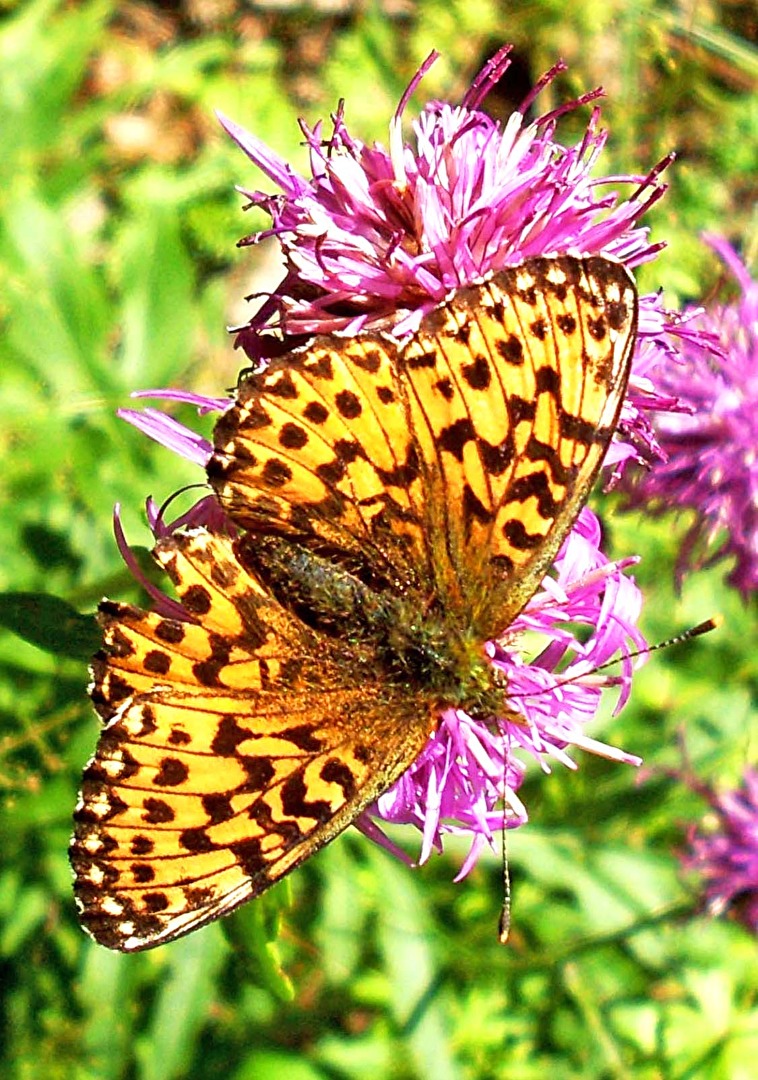







Large Pearl-bordered FritillaryLarge Pearl-bordered FritillaryGroßer Perlmuttfalter
The butterflies have a wingspan of 50 to 55 millimeters and, with their size slightly smaller than that of the Silver-washed Fritillary (Argynnis paphia), are among the largest European fritillaries. They have orange or yellow-brown upper wings patterned with black spots and crossbands. The wing edges are broadly dark-bordered. Behind this border are triangular spots that extend into the black edge. The undersides of the hindwings are yellow-brown, with the inner two-thirds, or basal half, slightly greenish and featuring numerous light pearly spots. Along the outer edge of the wings, there are also rows of light spots. The undersides of the forewings are more orange-colored and display black spots. Males have scent scales on three slightly widened longitudinal veins in the rear part of the forewings, which release pheromones to attract females.The butterflies have a wingspan of 50 to 55 millimeters and, with their size slightly smaller than that of the Silver-washed Fritillary (Argynnis paphia), are among the largest European fritillaries. They have orange or yellow-brown upper wings patterned with black spots and crossbands. The wing edges are broadly dark-bordered. Behind this border are triangular spots that extend into the black edge. The undersides of the hindwings are yellow-brown, with the inner two-thirds, or basal half, slightly greenish and featuring numerous light pearly spots. Along the outer edge of the wings, there are also rows of light spots. The undersides of the forewings are more orange-colored and display black spots. Males have scent scales on three slightly widened longitudinal veins in the rear part of the forewings, which release pheromones to attract females.Die Falter erreichen eine Flügelspannweite von 50 bis 55 Millimetern und sind mit ihrer Größe, die etwas kleiner als die des Kaisermantels (Argynnis paphia) ist, eine der größten europäischen Perlmuttfalter. Sie haben orangefarbene oder gelbbraune Flügeloberseiten, die mit schwarzen Flecken und Querbändern gemustert sind. Der Flügelrand ist breit dunkel gesäumt. Dahinter reihen sich Dreiecksflecken, die in den schwarzen Rand hineinreichen. Die Flügelunterseiten der Hinterflügel sind gelbbraun, in den zwei inneren Dritteln, bzw. in der Basalhälfte, sind sie leicht grünlich und haben zahlreiche, helle Perlmuttflecken. Am Flügelaußenrand sind ebenfalls helle Flecken gereiht. Die Unterseiten der Vorderflügel sind mehr orange gefärbt und weisen schwarze Flecken auf. Die Männchen besitzen auf drei nur leicht verbreiterten Längsadern im hinteren Teil der Vorderflügel Duftschuppen, welche Pheromone abgeben um Weibchen anzulocken.