

Information
| Hits | 4290 |
| Comments | 0 |
| Published | 07.05.2025, 09:18 07.05.2025 |
| Licence | BY-ND |
| Photo ID | [pc-foto:76139] |
| Hits | 4290 |
| Comments | 0 |
| Published | 07.05.2025, 09:18 07.05.2025 |
| Licence | BY-ND |
| Photo ID | [pc-foto:76139] |





Astrolabe ClockAstrolabe ClockAstrolabiumsuhr
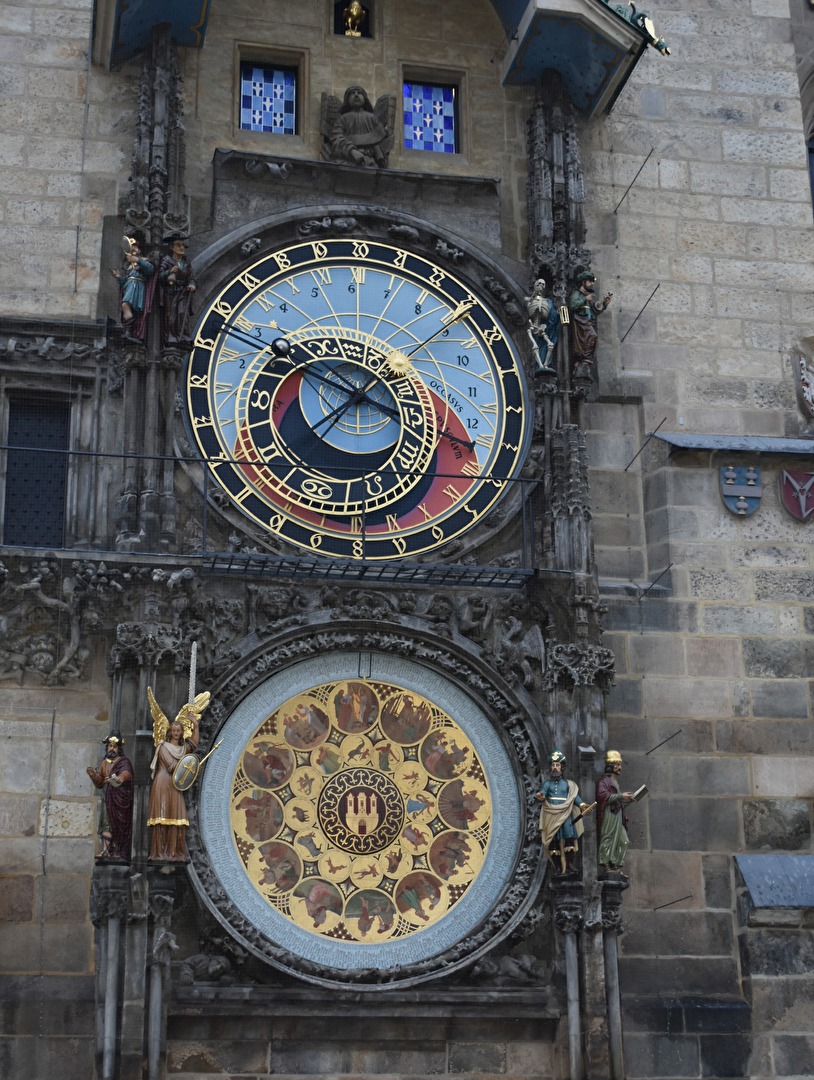
The Prague Astronomical Clock is embedded in the south facade of the Old Town Hall at the Old Town Square. It is an astrolabe clock from the early 15th century in southern projection. In addition to the time and the astronomical phenomena displayed by the astrolabe, it uniquely shows Italian or Bohemian hours, counted from sunset, on a rotating outer ring. Below the astrolabe clock is a calendar disc from the late 15th century. The figurine shows on both sides of the clock were added in the 17th century, while the procession of the 12 Apostles was installed at an unknown later date above the clock behind two windows.In the final days of World War II, the clock suffered severe damage during a German attack, and the town hall was completely burned down. Through extensive restoration work in 1948, the clock's original condition was restored.The Prague Astronomical Clock is embedded in the south facade of the Old Town Hall at the Old Town Square. It is an astrolabe clock from the early 15th century in southern projection. In addition to the time and the astronomical phenomena displayed by the astrolabe, it uniquely shows Italian or Bohemian hours, counted from sunset, on a rotating outer ring. Below the astrolabe clock is a calendar disc from the late 15th century. The figurine shows on both sides of the clock were added in the 17th century, while the procession of the 12 Apostles was installed at an unknown later date above the clock behind two windows.
In the final days of World War II, the clock suffered severe damage during a German attack, and the town hall was completely burned down. Through extensive restoration work in 1948, the clock's original condition was restored.Die Prager Rathausuhr ist in die Südfassade des alten Rathauses am Altstädter Ring eingearbeitet. Sie ist eine aus dem Anfang des 15. Jahrhunderts stammende Astrolabiumsuhr in südlicher Projektion. Neben der Uhrzeit und den mit dem Astrolabium darstellbaren astronomischen Sachverhalten zeigt sie als Besonderheit auf einem drehenden äußeren Ring die ab Sonnenuntergang gezählten italienischen oder böhmischen Stunden an. Unterhalb der Astrolabiumsuhr befindet sich eine Kalenderscheibe vom Ende des 15. Jahrhunderts. Die Figurenspiele zu beiden Seiten der Uhr kamen im 17. Jahrhundert hinzu, während das Spiel mit den 12 Aposteln in unbekannter späterer Zeit oberhalb der Uhr hinter den beiden Fenstern angebracht wurde.
In den letzten Tagen des Zweiten Weltkrieges erlitt die Uhr schwere Schäden während eines deutschen Angriffs, wobei das Rathaus vollständig abbrannte. Durch aufwendige Restaurierungsarbeiten im Jahre 1948 konnte der Originalzustand der Uhr wiederhergestellt werden.