NGC 281 Pacman NebulaNGC 281 Pacman NebulaNGC 281 Pacman-Nebel
NGC281 Pacman Nebula, stacked from 94 images with 300 seconds exposure each (7h40m).
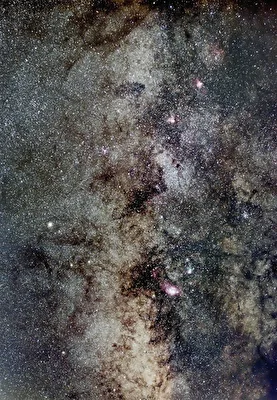
NGC 281 is an emission nebula in the constellation Cassiopeia in the northern sky, located 9,500 light-years from Earth. The nebula is cataloged as IC 11 in the Index Catalogue and is colloquially known as the Pac-Man Nebula, especially in English-speaking regions, due to its resemblance to the famous video game character of the same name. Embedded within NGC 281 is the open star cluster IC 1590, whose stars are scattered around the center of the nebula, with some standing out due to their X-ray emissions. The brightest member of IC 1590, the multiple star system BD +55° 191 (HD 5005), is the ionizing source of the nebula. The nebula also contains several Bok globules, where infrared observations have revealed signs of star formation. Infrared images also show the molecular cloud, whose ionized part forms the emission nebula.NGC281 Pacman Nebula, stacked from 94 images with 300 seconds exposure each (7h40m).
NGC 281 is an emission nebula in the constellation Cassiopeia in the northern sky, located 9,500 light-years from Earth. The nebula is cataloged as IC 11 in the Index Catalogue and is colloquially known as the Pac-Man Nebula, especially in English-speaking regions, due to its resemblance to the famous video game character of the same name. Embedded within NGC 281 is the open star cluster IC 1590, whose stars are scattered around the center of the nebula, with some standing out due to their X-ray emissions. The brightest member of IC 1590, the multiple star system BD +55° 191 (HD 5005), is the ionizing source of the nebula. The nebula also contains several Bok globules, where infrared observations have revealed signs of star formation. Infrared images also show the molecular cloud, whose ionized part forms the emission nebula.NGC281 Pacman Nebel, gestackt aus 94 Bildern mit je 300sec Belichtungszeit. (7h40m)
NGC 281 ist ein Emissionsnebel im Sternbild Kassiopeia am Nordsternhimmel, der 9500 Lichtjahre von der Erde entfernt ist. Der Nebel ist im Index-Katalog als IC 11 erfasst und wird umgangssprachlich wegen seiner Ähnlichkeit mit der bekannten gleichnamigen Videospiel-Hauptfigur vor allem im englischen Sprachraum auch als Pac-Man-Nebel bezeichnet. In NGC 281 ist der offene Sternhaufen IC 1590 eingebettet, dessen Sterne um das Zentrum des Nebels verstreut sind und von denen einige durch ihre Röntgenstrahlung hervortreten. Das hellste Mitglied von IC 1590, das Mehrfachsternsystem BD +55° 191 (HD 5005), ist die ionisierende Quelle des Nebels. Der Nebel enthält auch mehrere Bok-Globulen, in denen durch Infrarotaufnahmen Anzeichen für Sternentstehung festgestellt werden konnten. Ebenfalls in Infrarotaufnahmen ist die Molekülwolke erkennbar, deren ionisierter Teil der Emissionsnebel ist.







NGC 281 Pacman NebulaNGC 281 Pacman NebulaNGC 281 Pacman-Nebel
NGC281 Pacman Nebula, stacked from 94 images with 300 seconds exposure each (7h40m).NGC 281 is an emission nebula in the constellation Cassiopeia in the northern sky, located 9,500 light-years from Earth. The nebula is cataloged as IC 11 in the Index Catalogue and is colloquially known as the Pac-Man Nebula, especially in English-speaking regions, due to its resemblance to the famous video game character of the same name. Embedded within NGC 281 is the open star cluster IC 1590, whose stars are scattered around the center of the nebula, with some standing out due to their X-ray emissions. The brightest member of IC 1590, the multiple star system BD +55° 191 (HD 5005), is the ionizing source of the nebula. The nebula also contains several Bok globules, where infrared observations have revealed signs of star formation. Infrared images also show the molecular cloud, whose ionized part forms the emission nebula.NGC281 Pacman Nebula, stacked from 94 images with 300 seconds exposure each (7h40m).
NGC 281 is an emission nebula in the constellation Cassiopeia in the northern sky, located 9,500 light-years from Earth. The nebula is cataloged as IC 11 in the Index Catalogue and is colloquially known as the Pac-Man Nebula, especially in English-speaking regions, due to its resemblance to the famous video game character of the same name. Embedded within NGC 281 is the open star cluster IC 1590, whose stars are scattered around the center of the nebula, with some standing out due to their X-ray emissions. The brightest member of IC 1590, the multiple star system BD +55° 191 (HD 5005), is the ionizing source of the nebula. The nebula also contains several Bok globules, where infrared observations have revealed signs of star formation. Infrared images also show the molecular cloud, whose ionized part forms the emission nebula.NGC281 Pacman Nebel, gestackt aus 94 Bildern mit je 300sec Belichtungszeit. (7h40m)
NGC 281 ist ein Emissionsnebel im Sternbild Kassiopeia am Nordsternhimmel, der 9500 Lichtjahre von der Erde entfernt ist. Der Nebel ist im Index-Katalog als IC 11 erfasst und wird umgangssprachlich wegen seiner Ähnlichkeit mit der bekannten gleichnamigen Videospiel-Hauptfigur vor allem im englischen Sprachraum auch als Pac-Man-Nebel bezeichnet. In NGC 281 ist der offene Sternhaufen IC 1590 eingebettet, dessen Sterne um das Zentrum des Nebels verstreut sind und von denen einige durch ihre Röntgenstrahlung hervortreten. Das hellste Mitglied von IC 1590, das Mehrfachsternsystem BD +55° 191 (HD 5005), ist die ionisierende Quelle des Nebels. Der Nebel enthält auch mehrere Bok-Globulen, in denen durch Infrarotaufnahmen Anzeichen für Sternentstehung festgestellt werden konnten. Ebenfalls in Infrarotaufnahmen ist die Molekülwolke erkennbar, deren ionisierter Teil der Emissionsnebel ist.