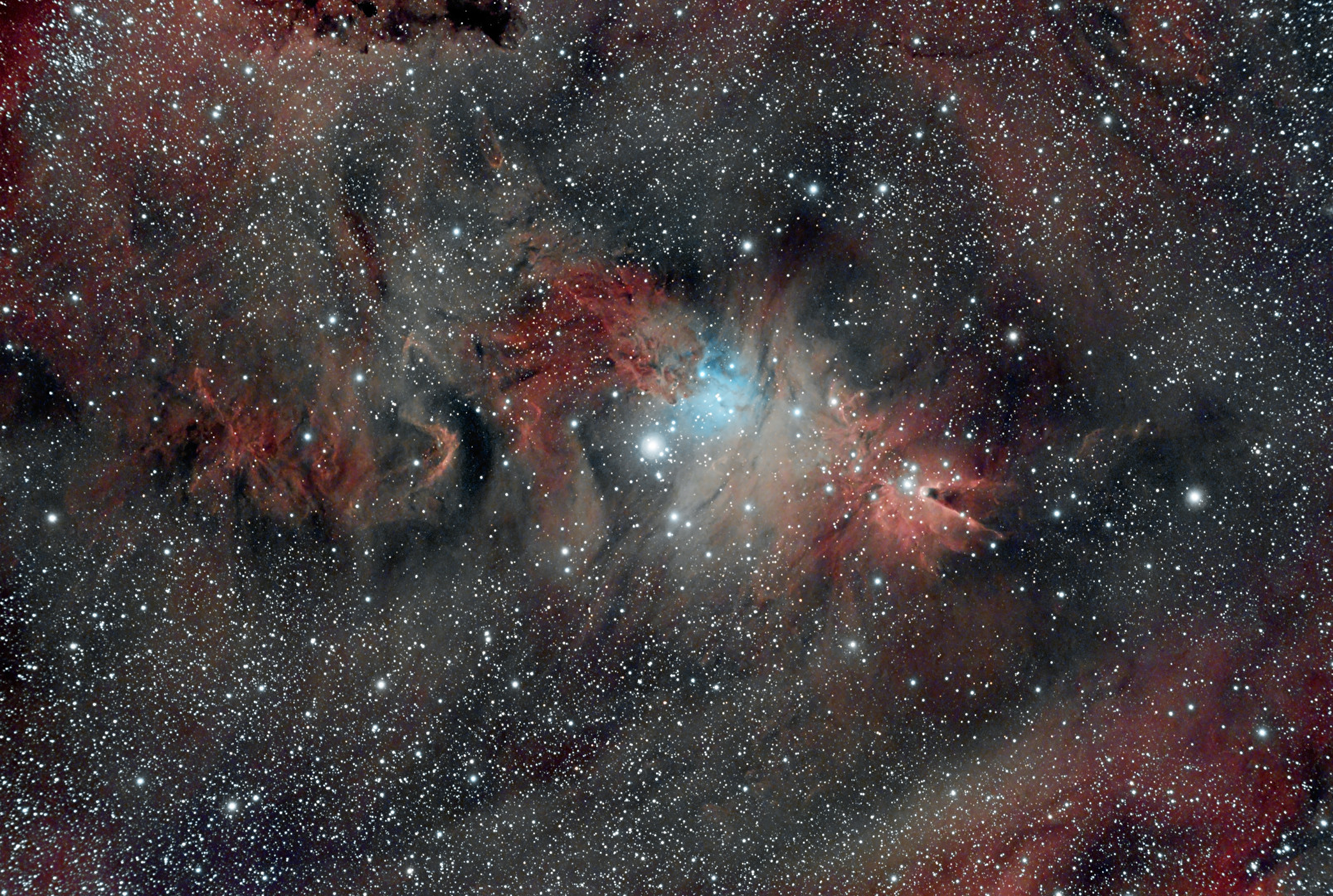
Christmas Tree Nebula
The individual components are often mislabeled, for example, the H II region alone is sometimes called NGC 2264. However, the New General Catalogue designates the entire complex of the H II region, open star cluster, and diffuse nebula as number 2264.
The object was discovered on January 18, 1784, by William Herschel. (Wiki)' role="button">
Michael Geissel
The object was discovered on January 18, 1784, by William Herschel. (Wiki)' role="button">




Information
Exif
| Date | 26.12.2024 |







Christmas Tree NebulaChristmas Tree NebulaWeihnachtsbaumnebel
Finally able to use a clear sky again. From last night, NGC 2264 Christmas Tree Nebula, unfortunately only with 3.25 hours of exposure time.NGC 2264 describes an area consisting of part of an H II region (with a dark cloud in front, the Cone Nebula), a star cluster (the Christmas Tree Cluster), and the diffuse nebula in between. It is located about 2,500 light-years away in the constellation Monoceros and measures 40.0' × 40.0' with an apparent magnitude of 4.1.
The individual components are often mislabeled, for example, the H II region alone is sometimes called NGC 2264. However, the New General Catalogue designates the entire complex of the H II region, open star cluster, and diffuse nebula as number 2264.
The object was discovered on January 18, 1784, by William Herschel. (Wiki)Finally able to use a clear sky again. From last night, NGC 2264 Christmas Tree Nebula, unfortunately only with 3.25 hours of exposure time.
NGC 2264 describes an area consisting of part of an H II region (with a dark cloud in front, the Cone Nebula), a star cluster (the Christmas Tree Cluster), and the diffuse nebula in between. It is located about 2,500 light-years away in the constellation Monoceros and measures 40.0' × 40.0' with an apparent magnitude of 4.1.
The individual components are often mislabeled, for example, the H II region alone is sometimes called NGC 2264. However, the New General Catalogue designates the entire complex of the H II region, open star cluster, and diffuse nebula as number 2264.
The object was discovered on January 18, 1784, by William Herschel. (Wiki)Endlich mal wieder ein klaren Himmel nutzen können. Aus letzter Nacht NGC2264 Weihnachtsbaumnebel, leider nur mit 3,25 Stunden Belichtungszeit.
NGC 2264 beschreibt ein Gebiet, das aus einem Teil eines H-II-Gebiets (mit einer davor liegenden Dunkelwolke, dem Konusnebel), einem Sternhaufen (dem Weihnachtsbaum-Sternhaufen) und dem diffusen Nebel dazwischen besteht. Es befindet sich in etwa 2500 Lichtjahren Entfernung im Sternbild Einhorn und hat die Abmessungen 40,0&039; × 40,0&039; und eine scheinbare Helligkeit von 4,1 mag.
Oft werden die Einzelkomponenten falsch bezeichnet. So z. B. die H-II-Region alleine als NGC 2264. Der New General Catalogue jedoch bezeichnet die Gesamtheit aus H-II-Gebiet, offenem Sternhaufen und diffusem Nebel mit der Nummer 2264.
Das Objekt wurde am 18. Januar 1784 von Wilhelm Herschel entdeckt. (Wiki)