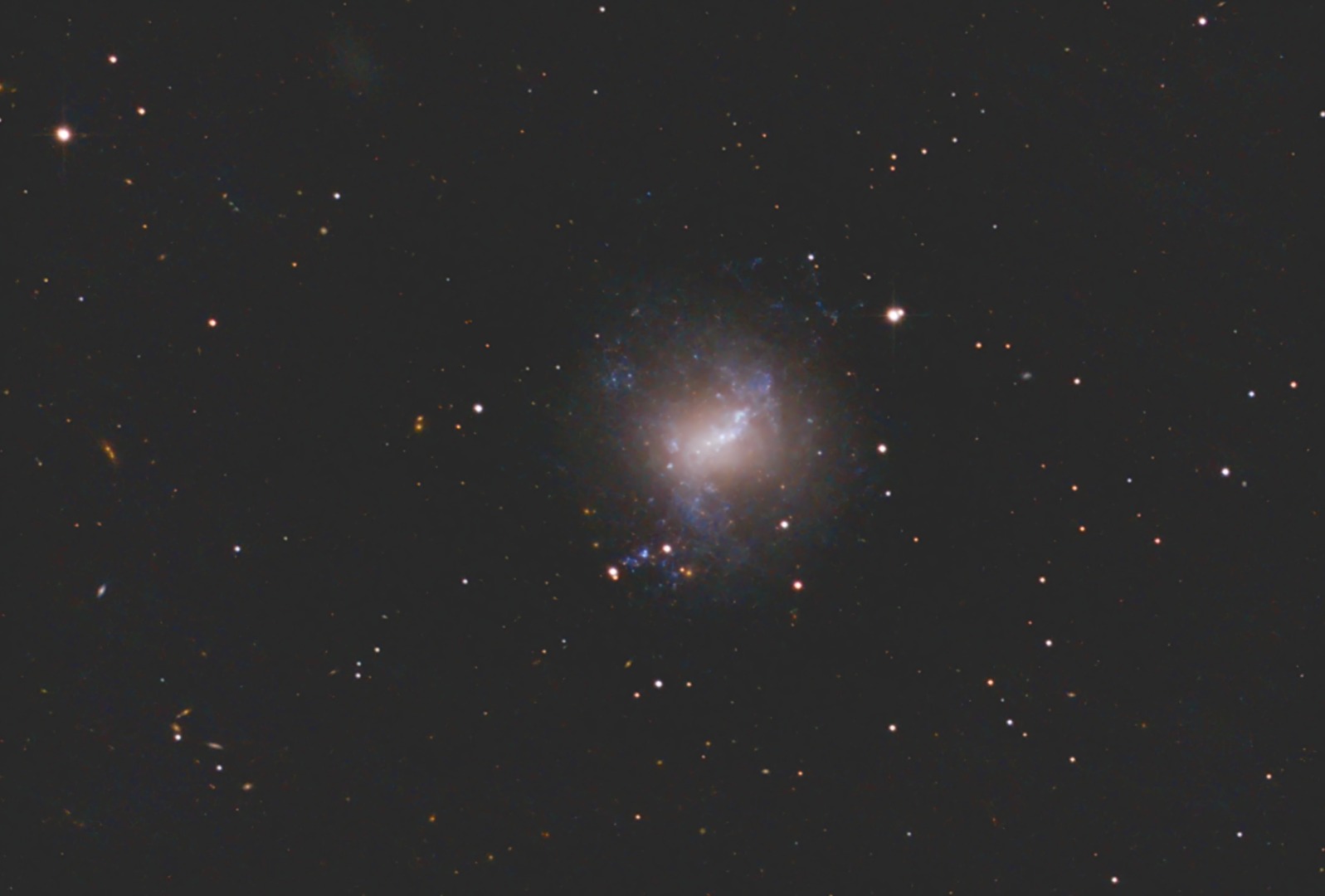
NGC4214, a dwarf galaxy with nearly 3 hours of exposure time.
NGC 4214 = NGC 4228 is an irregular galaxy with extensive star-forming regions of Hubble type IBm in the constellation Canes Venatici in the northern sky. It is estimated to be 14 million light-years away from the Milky Way and has a diameter of about 30,000 light-years.
In the same sky area are the galaxies NGC 4163 and NGC 4190.
Many new stars and star clusters are forming in this galaxy, recognizable by the white-blue light. Scientists suspect that the massive stars in the central star cluster will soon explode as supernovae. (Wiki)NGC4214, a dwarf galaxy with nearly 3 hours of exposure time.
NGC 4214 = NGC 4228 is an irregular galaxy with extensive star-forming regions of Hubble type IBm in the constellation Canes Venatici in the northern sky. It is estimated to be 14 million light-years away from the Milky Way and has a diameter of about 30,000 light-years.
In the same sky area are the galaxies NGC 4163 and NGC 4190.
Many new stars and star clusters are forming in this galaxy, recognizable by the white-blue light. Scientists suspect that the massive stars in the central star cluster will soon explode as supernovae. (Wiki)NGC4214 eine Zwerggalaxie mit knapp 3 Stunden Belichtungszeit.
NGC 4214 = NGC 4228 ist eine irreguläre Galaxie mit ausgedehnten Sternentstehungsgebieten vom Hubble-Typ IBm im Sternbild Jagdhunde am Nordsternhimmel. Sie ist schätzungsweise 14 Millionen Lichtjahre von der Milchstraße entfernt und hat einen Durchmesser von etwa 30.000 Lichtjahren.
Im selben Himmelsareal befinden sich die Galaxien NGC 4163 und NGC 4190.
In dieser Galaxie entstehen viele neue Sterne und Sternhaufen, zu erkennen an dem weiß-bläulichen Licht. Wissenschaftler vermuten, dass die massereichen Sterne des Sternhaufens im Zentrum schon bald als Supernovae explodieren werden. (Wiki)









Dwarf Galaxy NGC4214Dwarf Galaxy NGC4214Zwerggalaxie NGC4214
NGC4214, a dwarf galaxy with nearly 3 hours of exposure time.NGC 4214 = NGC 4228 is an irregular galaxy with extensive star-forming regions of Hubble type IBm in the constellation Canes Venatici in the northern sky. It is estimated to be 14 million light-years away from the Milky Way and has a diameter of about 30,000 light-years.
In the same sky area are the galaxies NGC 4163 and NGC 4190.
Many new stars and star clusters are forming in this galaxy, recognizable by the white-blue light. Scientists suspect that the massive stars in the central star cluster will soon explode as supernovae. (Wiki)NGC4214, a dwarf galaxy with nearly 3 hours of exposure time.
NGC 4214 = NGC 4228 is an irregular galaxy with extensive star-forming regions of Hubble type IBm in the constellation Canes Venatici in the northern sky. It is estimated to be 14 million light-years away from the Milky Way and has a diameter of about 30,000 light-years.
In the same sky area are the galaxies NGC 4163 and NGC 4190.
Many new stars and star clusters are forming in this galaxy, recognizable by the white-blue light. Scientists suspect that the massive stars in the central star cluster will soon explode as supernovae. (Wiki)NGC4214 eine Zwerggalaxie mit knapp 3 Stunden Belichtungszeit.
NGC 4214 = NGC 4228 ist eine irreguläre Galaxie mit ausgedehnten Sternentstehungsgebieten vom Hubble-Typ IBm im Sternbild Jagdhunde am Nordsternhimmel. Sie ist schätzungsweise 14 Millionen Lichtjahre von der Milchstraße entfernt und hat einen Durchmesser von etwa 30.000 Lichtjahren.
Im selben Himmelsareal befinden sich die Galaxien NGC 4163 und NGC 4190.
In dieser Galaxie entstehen viele neue Sterne und Sternhaufen, zu erkennen an dem weiß-bläulichen Licht. Wissenschaftler vermuten, dass die massereichen Sterne des Sternhaufens im Zentrum schon bald als Supernovae explodieren werden. (Wiki)